1000Hz Monitor Is the Future of Esports — But Here Is the Honest Picture
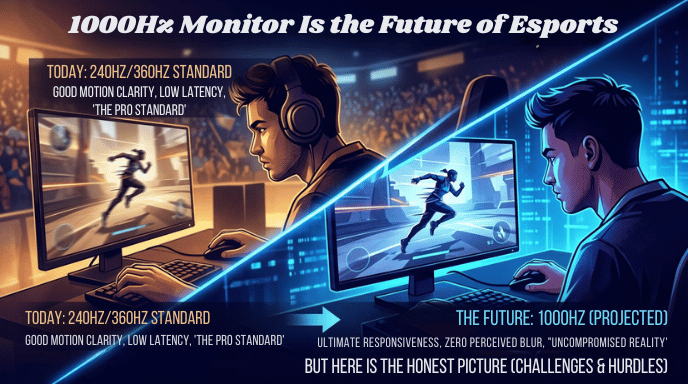
In May 2026, Philips Evnia and Chinese display giant BOE announced the Evnia Native FHD IPS 1000Hz Eye-Care Gaming Monitor 25M4P5200T — the world's first truly native 1000Hz hardware display. Not interpolated. Not software-boosted. Native. A full 1,920×1,080 frame delivered every single millisecond, one thousand times per second.
Within weeks, AOC and Philips had both unveiled 1000Hz native panels developed with BOE. LG announced their own native 1000Hz Full HD gaming monitor. ASUS had their ROG Strix Ace XG248QSG running at 610Hz in production and was teasing OLED panels for esports. The refresh rate race — which sat comfortably at 360Hz for several years before 500Hz and 540Hz pushed into the market — has now crossed a threshold that sounds like science fiction.
So is 1000Hz the future of esports? The answer is yes, eventually — but with more nuance than most tech headlines are willing to give you.
What 1000Hz Actually Means
At 60Hz, your monitor refreshes 60 times per second. Each frame is displayed for 16.67 milliseconds before the next one replaces it. At 240Hz, each frame lasts 4.16 milliseconds. At 1000Hz, each frame lasts exactly 1 millisecond — after which it is gone and the next one arrives.
This matters for one specific reason: sample-and-hold blur. In a sample-and-hold display, each frame is held on screen until the next frame arrives. Your eyes naturally track moving objects, but the display is not moving — it is frozen in place while your eyes pan across it. The mismatch between where your eyes expect an object to be and where it is actually displayed on the static frame creates motion blur. Higher refresh rates reduce this problem by shortening the time each frame is held, which means objects appear in more accurate positions more often relative to your eye movement.
At 1000Hz, each frame is held for only 1 millisecond before being replaced. The stroboscopic effect — the jagged, stuttering appearance of fast movement at low refresh rates — effectively disappears. Motion appears genuinely smooth in a way that lower refresh rates cannot achieve even with backlight strobing or motion blur reduction tricks.
The AOC AGON PRO 1000Hz gaming monitor puts it plainly: a 1000Hz refresh rate delivers a new frame every 1 millisecond, compared to 2 milliseconds at 500Hz and 4.16 milliseconds at 240Hz. That is not a marketing number — it is a physics fact about display persistence.
The Real Technical Breakthrough: Native vs Interpolated
Here is the distinction that matters most and that most marketing glosses over. Before the Philips Evnia 25M4P5200T, what manufacturers called "1000Hz" was achieved through frame interpolation — the display generated intermediate frames between real rendered frames, effectively manufacturing the high refresh rate artificially. This process introduces its own latency and image artifacts. The interpolated frames are not real frames; they are guesses.
The Philips Evnia is different. It uses BOE's next-generation native FHD 1000Hz IPS panel for true hardware-native output, meaning every one of the thousand frames per second is an actual rendered frame at full 1,920×1,080 resolution with no interpolation artifacts and no added latency. This is the genuine breakthrough — not the number itself, but the fact that the number is now being achieved correctly.
This distinction is why previous "1000Hz" marketing claims were dismissed by serious reviewers, and why the BOE panel announcement in mid-2026 is treated as a genuinely significant milestone in display technology rather than a spec sheet boast.
The Dual-Mode Reality
There is a catch, and it is worth understanding before you start planning a purchase. Running 1000Hz at full 1080p resolution requires enormous data bandwidth — specifically DisplayPort 2.1 at minimum. The AOC AGON PRO AGP277QK addresses this with a dual-mode design: in its standard mode, the panel runs at QHD (2560×1440) resolution at 500Hz. In extreme performance mode, it switches to 1000Hz at a lower HD resolution.
This means the practical use of a 1000Hz monitor involves actively choosing between image quality and maximum refresh rate depending on what you are doing. For a ranked Valorant or CS2 match where every millisecond of target acquisition matters, you run 1000Hz at 1080p. For a casual session or a slower-paced game where visual fidelity matters more, you run QHD at 500Hz.
This is not a flaw — it is an honest engineering trade-off given current DisplayPort bandwidth limits. Future iterations as DisplayPort technology advances will likely push the ceiling higher. But for the first generation of 1000Hz monitors available in 2026, dual-mode operation is the practical reality.
The Hardware Requirement Nobody Is Talking About Enough
A 1000Hz monitor does precisely nothing for you if your GPU cannot deliver 1000 frames per second. A monitor can only display what your graphics card renders. This is the most fundamental constraint of high-refresh-rate gaming and it becomes more severe at each tier.
Achieving 1000 FPS consistently is only possible in a narrow category of lightweight esports titles — CS2, Valorant, League of Legends, Overwatch 2, Fortnite at minimum settings — on high-end hardware. Even with an RTX 5090 or AMD RX 9070 XT, sustaining 1000 FPS in any moderately demanding game requires running at minimum visual settings and 1080p resolution. Professional esports tournaments almost universally use 24-inch 1080p displays for exactly this reason: lower resolution means more GPU headroom for higher frame rates.
If your system is producing 400 FPS in CS2, a 1000Hz monitor gives you no additional advantage over a 400Hz monitor. The monitor cannot conjure frames that the GPU has not rendered. Every review of 1000Hz technology worth reading leads with this caveat.
The required system for genuine 1000Hz benefit: a top-tier GPU producing sustained 1000+ FPS in your game of choice, a high-end CPU to prevent frame pacing bottlenecks, and a DisplayPort 2.1 cable. This is not a ₹1.5 lakh gaming PC situation. It is a dedicated, meticulously optimised esports setup.
Can You Actually See the Difference?
This is the question that divides hardware enthusiasts from competitive players, and the research gives a nuanced answer rather than a clean one.
Human visual perception does not have a single refresh rate ceiling. The commonly cited "the human eye can only see 60fps" claim is demonstrably false — studies consistently show that trained individuals can perceive differences well beyond 200Hz under controlled conditions. But the gains follow a logarithmic curve. The difference between 60Hz and 144Hz is enormous and perceivable by almost everyone. The difference between 144Hz and 240Hz is meaningful and perceivable by most gamers. The difference between 360Hz and 500Hz narrows considerably. And the difference between 500Hz and 1000Hz?
Research indicates the eye can detect reduced stroboscopic stepping and smoother tracking at higher refresh rates, but the improvement from 500Hz to 1000Hz is smaller than earlier jumps from 60Hz to 120Hz. The benefit is more about visual comfort and reduced cognitive load than an obvious, dramatic visual transformation.
For professional esports athletes — players whose performance margins are measured in fractions of a second, who train extensively, and who play thousands of hours in specific titles — even this marginal improvement in motion clarity may translate to a measurable competitive edge. Studies on esports players show they have measurably higher working memory and cognitive tracking ability compared to the general population. At that level of perceptual training, sub-millisecond advantages compound.
For a ranked player who games 3–4 hours per week, the difference between 360Hz and 1000Hz will be essentially imperceptible in practice. The difference between 144Hz and 360Hz, however, is still very real and worth pursuing first.
The Esports Pro Scene: When Will 1000Hz Enter Tournaments?
Professional esports tournaments are conservative about hardware adoption. The transition from 240Hz to 360Hz tournament standards took several years after 360Hz monitors became commercially available. The reasons are practical: consistency across event setups, cost, driver stability, and the need for every player to compete on identical hardware.
1000Hz monitors in 2026 are at the announcement and early retail stage. Tournament-grade adoption — where the hardware is battle-tested, stable across different system configurations, and available at scale for event deployment — typically lags consumer availability by 18–36 months.
Realistically, 1000Hz monitors will enter professional esports tournament consideration in 2027–2028, assuming the technology stabilises and GPU hardware capable of sustaining 1000 FPS in tournament titles becomes more accessible. The 2026 announcements from Philips Evnia, AOC, and LG are setting the foundation — not the immediate tournament standard.
ASUS ROG's trajectory is instructive here. The company ushered in the world's first consumer gaming display at 144Hz in 2012. The current ROG Strix Ace runs at 610Hz for esports. Their roadmap clearly points toward 1000Hz OLED panels as the next milestone — and ASUS's track record of timing technology introductions to professional adoption windows is strong.
1000Hz vs 500Hz vs 360Hz: Which Should You Actually Buy?
The honest comparison:
Moving from 144Hz to 240Hz is the single highest-impact refresh rate upgrade available. If you are on 144Hz or below, this is where you start. The difference is immediate and perceivable by almost anyone in fast-paced games.
Moving from 240Hz to 360Hz is meaningful for serious competitive players. Motion clarity improves noticeably in tracking-intensive games like CS2 and Valorant. This is the tier where professional and high-ranked players currently operate.
Moving from 360Hz to 500Hz or 540Hz offers real but diminishing returns. The perceptual difference requires a trained eye and a system capable of sustaining the frame rate. Worth it for dedicated competitors; overkill for the majority.
Moving from 500Hz to 1000Hz in 2026 is primarily for professional esports athletes, hardware enthusiasts, and early adopters who want to be at the absolute edge of what exists. The perceptual benefit is real but requires the hardware to deliver it, the trained perception to detect it, and the willingness to pay a premium for technology that will be mainstream in 3–4 years at a fraction of the current cost.
The Broader Trajectory: Why This Matters Beyond the Spec Sheet
The launch of native 1000Hz technology in 2026 matters for reasons beyond who can buy it today. It establishes the ceiling from which future technology will iterate. Panel manufacturing techniques that can produce native 1000Hz IPS at 1080p today will produce native 1000Hz QHD next, and native 1000Hz 1440p after that, as DisplayPort bandwidth and GPU rendering power advance in parallel.
The same logarithmic pattern that played out from 60Hz to 360Hz over a decade will play out from 360Hz to 1000Hz over the next several years — but compressed, because the manufacturing and engineering knowledge is already in place. What costs a premium today will be mid-range tomorrow.
OLED panels are advancing on a parallel track. ASUS is already teasing 540Hz OLED panels at esports sizes. The convergence of OLED's sub-0.1ms response time with 1000Hz refresh rates will represent the genuine end-state of competitive gaming display technology — motion that approaches visual perfection for the human perceptual system.
The Bottom Line
Yes, 1000Hz monitors are the future of esports. The physics is correct, the technology milestone is genuine, and the path from today's niche professional tool to tomorrow's tournament standard is well-established by every previous refresh rate transition.
No, you almost certainly do not need one right now — unless you are a professional player or a serious hardware enthusiast with a system capable of actually feeding it. The hardware requirements are substantial, the perceptual gains over 360Hz–500Hz are measurable but not dramatic for most players, and the price premium of first-generation technology is real.
The smartest position is this: if you are currently on 144Hz, upgrade to 240Hz or 360Hz today — that is where the real competitive gain lives in 2026. If you are already on 360Hz or above and you play at the professional or semi-professional level, watch the 1000Hz market closely. First-generation monitors will be refined over the next 12–18 months, GPU hardware will catch up, and pricing will normalise.
The 1000Hz era has genuinely arrived. Whether it has arrived for you depends on what is already on your desk.
Display specifications from Philips Evnia 25M4P5200T product announcement, AOC AGON PRO AGP277QK specifications, and ASUS ROG monitor lineup as of June 2026. Refresh rate perception research from KTC Play and Newegg Insider 2026 analyses. Human perception research referenced from Blur Busters Law documentation. All pricing expectations are estimates based on current market positioning of comparable high-refresh displays.
