How to Use AI to Make Money in 2026: The Realistic Guide
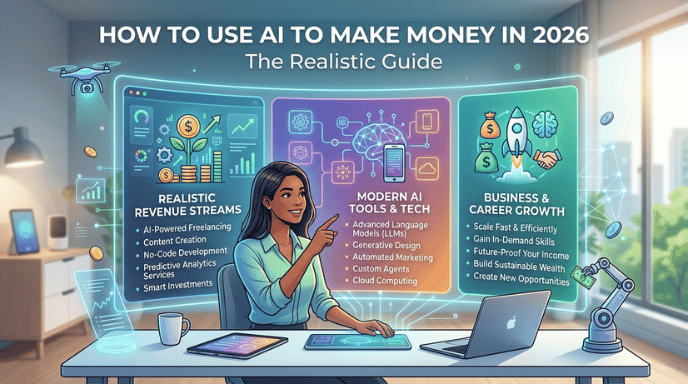
The AI money-making conversation in 2026 has bifurcated sharply. On one side: a flood of YouTube thumbnails promising ₹1 lakh per month in two weeks. On the other: people who actually understand the tools and are quietly building sustainable income around them.
This guide is written for the second camp — or for anyone who wants to join it.
The honest framing first: AI is not a money printer. It is a leverage multiplier. It makes skilled people faster, more prolific, and more capable of delivering value at scale. The income comes from the value delivered, not from the fact that AI was involved. What has changed is that the ceiling on how much value one person can produce in a working day has risen dramatically — and that creates real, meaningful income opportunities for people who know how to use the tools.
AI adoption is growing quickly, with 75% of small businesses already using or exploring AI — and most of them are hiring or paying for AI-assisted services rather than building those capabilities in-house. That gap is the business opportunity.
Here is what is actually working, organised by the time and skill required to get started.
The Core Principle: AI as a Force Multiplier
Before the methods, the mindset shift that separates people who build sustainable income from people who burn out chasing gimmicks:
Stop treating AI like a financial lottery ticket and start treating it as a leverage multiplier. Find a problem people are already paying to solve, inject the right AI architecture, and capture the value.
The question is not "how can I make money with AI?" It is "what do businesses or people already pay for, and how can I deliver it faster, better, or at greater scale using AI tools?"
Every method below is an answer to that question.
Method 1: AI-Assisted Freelance Writing and Content
Time to first income: 7–14 days Investment required: ₹0 (free tools sufficient to start) Realistic income range: ₹10,000–₹1.5 lakh/month depending on experience and volume Best platforms: Fiverr, Upwork, LinkedIn, direct outreach
This is the most accessible entry point for most people, and still one of the most lucrative when done right.
The model: businesses need blog posts, SEO articles, product descriptions, email sequences, LinkedIn content, and social media copy — continuously. A skilled writer using AI tools can produce 5–10× more content at consistent quality than without them. Using AI as a force-multiplier, skilled writers use tools like Claude, ChatGPT, and Surfer SEO to produce 5–10× more content at consistent quality. The key differentiator is human editorial judgment, SEO strategy, and brand voice calibration — skills AI cannot replicate but can dramatically accelerate.
What the market pays (2026):
- Blog posts and SEO articles: ₹1,500–₹8,000 per article (or $15–$100 for international clients)
- Product descriptions (e-commerce): ₹150–₹400 per product; batches of 50+ products are common
- LinkedIn content: ₹8,000–₹25,000 per month for 3–5 posts per week
- Email sequences: ₹3,000–₹12,000 per sequence
The 2026 market reality: The AI freelancing market is bifurcating. Generic "AI writing" gigs are dying. Niche AI micro-services are exploding. The people earning at the high end are not using AI to produce generic content — they are using it to produce specialised content in industries where they already have knowledge. A person with a background in finance writing financial content with AI assistance earns more than a person with no background writing generic blog posts with AI. Your domain knowledge is the differentiator; AI is the accelerant.
How to start:
- Pick a niche (healthcare, fintech, real estate, SaaS, education, travel)
- Create 3–5 sample articles in that niche using ChatGPT or Claude as a drafting tool, then edit heavily for accuracy, brand voice, and specificity
- List on Fiverr with a clear niche positioning (not "I write articles" — "I write SEO blog posts for SaaS companies")
- Apply on Upwork for content roles in your niche using a strong portfolio
- LinkedIn direct outreach to marketing managers at mid-size companies in your niche
Important: Fiverr launched an "AI Verified" badge system for sellers using disclosed AI tools. Sellers who proactively note their AI toolstack in gig descriptions are reportedly seeing higher conversion rates as buyers trust transparency. Disclose your AI use; it is a selling point now, not a liability.
Method 2: AI-Powered Social Media Management
Time to first income: 14–21 days Investment required: ₹0–₹2,000/month (Buffer or Hootsuite free tier to start) Realistic income range: ₹30,000–₹1.5 lakh/month per client Best platforms: LinkedIn direct outreach, local business networking
Businesses understand they need a social media presence. Most do not have the time, skill, or inclination to manage it themselves. A social media manager who uses AI tools can manage 3–5 brand accounts simultaneously — creating content calendars, drafting posts, generating image concepts for Canva, analysing performance data, and scheduling — in the time it previously took to manage one.
Tools: ChatGPT or Claude for content ideation and drafting; Canva AI for graphics; Buffer or Hootsuite for scheduling; Sprout Social or native analytics for reporting.
What the market pays:
- Small business account management (Instagram + LinkedIn + Facebook): ₹8,000–₹20,000/month
- Mid-size company (full content calendar + strategy): ₹25,000–₹60,000/month
- Running 3 small business accounts simultaneously: ₹24,000–₹60,000/month
The realistic path: Start with one small local business as a discounted or test client (₹5,000–₹8,000 for the first month) to build a case study. Document the before-and-after engagement metrics. Use that as your portfolio for the next three clients. By month 3–4, three paying clients at ₹15,000–₹25,000 each is a ₹45,000–₹75,000/month operation.
Method 3: AI Workflow Automation for Businesses
Time to first income: 21–45 days (learning curve is higher) Investment required: ₹0–₹5,000 (Zapier, Make.com have free tiers) Realistic income range: ₹50,000–₹5 lakh per project + monthly retainer Best platforms: LinkedIn, direct B2B outreach, local business communities
This is the gold mine of AI income in 2026. Most businesses have repetitive processes — lead routing, data entry, report generation, customer follow-up sequences, inventory alerts, social media responses — that are still done manually. Connecting AI tools to automate these processes delivers clear, measurable business value.
Even simple automations can be worth hundreds or thousands of dollars to companies because they save time and reduce manual work. The best part is that you can charge twice: first, a setup fee for building the workflow from scratch, and second, a monthly retainer for support, monitoring, updates, and fixing things when APIs change.
Tools to learn: Zapier (no-code automation), Make.com (more powerful), n8n (open-source, self-hostable), ChatGPT API (for AI-powered logic within workflows), Airtable or Notion for data management.
Example automation projects and what they're worth:
- Lead capture from website form → CRM entry → personalised follow-up email sent automatically: ₹15,000–₹30,000 setup + ₹5,000/month maintenance
- Invoice generation and payment follow-up automation for a small business: ₹20,000–₹40,000 setup
- Social media monitoring → sentiment analysis → alert when brand is mentioned negatively: ₹25,000–₹60,000 setup
- Inventory alert system for an e-commerce seller: ₹15,000–₹35,000 setup
How to start: Take Zapier's free certification course (online, 4–6 hours). Build 3 demo automations for hypothetical businesses in your portfolio. Approach small businesses in your local area — restaurants, clinics, real estate agents, coaching institutes — and offer a free audit of their manual processes. The conversion from audit to paid project is high because the value is visible.
Method 4: AI Video Production and Editing
Time to first income: 14–30 days Investment required: ₹0–₹3,000/month (CapCut free, InVideo has a free tier) Realistic income range: ₹15,000–₹3 lakh/month Best platforms: Fiverr, Upwork, Instagram/LinkedIn direct outreach to brands
AI video generation has made a quantum leap. Multimodal tools now allow creators to generate jaw-dropping promotional videos, social media ads, or cinematic content from simple text or audio inputs. Short-form video is the dominant content format for every platform and almost every business needs more of it than they can produce.
Two distinct sub-models:
Short-form content production: Creating Instagram Reels, YouTube Shorts, and TikTok-style content for businesses. Tools like CapCut AI, InVideo, and Descript automate scripting, voiceover, captioning, and B-roll selection. A skilled operator can produce 4–6 finished short-form videos per day — enough to serve 3–4 clients simultaneously.
AI video ads for e-commerce: Product video ads for Amazon listings, Flipkart, or performance marketing campaigns. A 30-second product ad that would cost ₹20,000–₹50,000 at an agency can be produced with AI tools for ₹2,000–₹5,000 in tool costs, leaving a strong margin.
What the market pays:
- Short-form video package (8 videos/month): ₹12,000–₹30,000 per client
- YouTube Shorts production (scripted, edited, captioned): ₹2,000–₹5,000 per video
- Product video ads for e-commerce: ₹5,000–₹15,000 per ad
Tools: CapCut AI (mobile + desktop, free), InVideo (text-to-video), Descript (transcript-based editing), ElevenLabs (AI voiceover), Runway (advanced AI video generation). ElevenLabs and Adobe Firefly both released major capability upgrades in late 2025, significantly improving voice naturalness and image generation realism.
Method 5: AI Graphic Design and Visual Content
Time to first income: 7–14 days Investment required: ₹0–₹1,500/month (Canva Pro) Realistic income range: ₹15,000–₹80,000/month Best platforms: Fiverr, Upwork, Instagram direct outreach
AI image generation and AI-assisted design tools have made it possible to produce professional visual content — social media graphics, YouTube thumbnails, presentation decks, brand identity kits, and ad creatives — with minimal design training.
Tools: Canva AI (the most accessible); Midjourney (best for original AI art and imagery); Adobe Firefly (integrated into Photoshop and Illustrator); Leonardo.ai (good for product imagery).
What's selling:
- Social media template packs (Etsy, Gumroad): ₹300–₹1,500 per pack; once created, sell repeatedly
- YouTube thumbnail design: ₹500–₹1,500 per thumbnail; volume work is consistent
- Presentation deck design: ₹5,000–₹20,000 per deck
- Brand identity kits (logo + colour palette + font kit): ₹8,000–₹25,000
The important caveat: Canva AI and Midjourney are tools, not skills. The skill is design judgment — understanding hierarchy, colour theory, what converts in an ad, what makes a thumbnail get clicked. People without this foundation tend to produce AI-generated content that looks AI-generated. The income ceiling on pure AI graphic generation without design sensibility is low; the ceiling with design sensibility plus AI tools is high.
Method 6: AI-Powered Data Analysis and Reporting
Time to first income: 21–45 days Investment required: ₹0 (Python is free; ChatGPT Code Interpreter is included in Plus) Realistic income range: ₹40,000–₹2 lakh/month Best platforms: Upwork, LinkedIn, direct B2B outreach
Businesses sit on data they do not know how to use. AI tools — particularly ChatGPT's Advanced Data Analysis mode (Code Interpreter) and Python libraries with AI-assisted coding — make it possible to analyse datasets, build dashboards, create automated reports, and generate insights that previously required a data analyst.
What this looks like practically: A retail business wants to understand which products are their most profitable per square foot. A startup wants a dashboard showing user acquisition by channel and cohort retention. A real estate agent wants a market trend report for their area. These are solvable with Excel data + ChatGPT Code Interpreter + basic Python, even for someone who is not a trained data scientist.
Tools: ChatGPT Plus (Advanced Data Analysis), Python (pandas, matplotlib, plotly), Power BI (data visualisation), Google Looker Studio (free dashboards).
What the market pays:
- One-time data analysis report: ₹5,000–₹25,000
- Monthly analytics dashboard + report: ₹15,000–₹40,000/month retainer
- E-commerce sales analysis: ₹8,000–₹20,000 per engagement
Method 7: Selling Digital Products Created with AI
Time to first income: 14–30 days Investment required: ₹0–₹2,000 Realistic income range: ₹5,000–₹2 lakh/month (highly variable; this is the most passive path) Best platforms: Gumroad, Etsy, Topmate, Instamojo
The appeal of digital products is that they are created once and sold repeatedly. AI accelerates the creation process dramatically — making what would have taken weeks possible in days.
What sells:
- Templates: Notion templates, Canva templates, Excel financial trackers, PowerPoint presentation frameworks. A well-designed Notion productivity system with AI-assisted structure sells for ₹299–₹1,500 and can move 100+ units per month on Gumroad or Topmate.
- eBooks and guides: AI assists in research, structuring, and drafting. A practical guide on a specific skill — "How to Use ChatGPT for Medical Writing" or "AI Tools for CA Students" — serves a niche with unmet demand.
- Prompt packs: Curated, tested prompt libraries for specific professions (lawyers, teachers, HR managers, content creators). Sell as a PDF or Notion page for ₹299–₹799.
- Stock content packs: AI-generated backgrounds, textures, social media templates, icon sets licensed for commercial use. Sold on Creative Market, Etsy, or directly.
The honest caveat: Most digital product launches generate disappointing sales without an audience or a marketing channel. The product must solve a specific, real problem; it must be marketed; and it must be discoverable. Building an Instagram or LinkedIn audience around your niche before launching a product dramatically improves conversion.
Method 8: AI Chatbot Setup for Small Businesses
Time to first income: 21–30 days Investment required: ₹0–₹3,000/month (ManyChat, Tidio, or Voiceflow have free tiers) Realistic income range: ₹15,000–₹60,000 per setup + monthly support Best platforms: Direct outreach to local businesses, LinkedIn
Small businesses — restaurants, clinics, coaching institutes, real estate agencies, salons — need customer-facing chatbots for WhatsApp, Instagram, and their websites. These bots answer FAQs, collect leads, book appointments, and handle basic customer service queries 24/7. A chatbot that handles 50 routine customer inquiries per day saves a business owner 2–3 hours of daily attention.
Tools: ManyChat (Instagram + WhatsApp automation), Tidio (website chatbot), Voiceflow (more sophisticated bot building), WhatsApp Business API (through providers like Wati or Interakt).
What the market pays:
- Basic FAQ chatbot for a website: ₹8,000–₹20,000 setup
- WhatsApp lead capture + follow-up bot: ₹12,000–₹30,000 setup
- Appointment booking bot for a clinic or salon: ₹15,000–₹35,000 setup
- Monthly maintenance and support: ₹3,000–₹8,000/month
Method 9: Teaching AI Skills
Time to first income: 30–60 days Investment required: ₹0–₹5,000 (recording setup if producing courses) Realistic income range: ₹20,000–₹5 lakh/month Best platforms: Udemy, Topmate, direct workshop sales (LinkedIn, Instagram)
AI literacy is one of the most in-demand skills in India, and the supply of quality instructors — especially those who can teach in clear, practical terms in Indian English and in regional languages — is far below demand.
Corporate training workshops for companies upskilling their employees are priced at ₹50,000–₹5 lakh per session. One-on-one AI consulting for entrepreneurs and freelancers is growing rapidly.
What's being taught (and paid for):
- Online courses on Udemy: "ChatGPT for Marketers," "AI Tools for HR Professionals," "Using AI in Content Writing" — a well-produced Udemy course can earn ₹10,000–₹50,000 per month passively
- Live workshops for corporate teams: 2–4 hour sessions priced at ₹30,000–₹1.5 lakh depending on company size
- 1-on-1 coaching for freelancers wanting to incorporate AI: ₹2,000–₹8,000 per session on Topmate
- Cohort-based courses: A 4-week "AI for Freelancers" cohort of 30 students at ₹5,000 each = ₹1.5 lakh per cohort
The credibility requirement: Teaching AI does not require being a machine learning engineer. It requires being genuinely ahead of your audience, having built real outcomes with the tools, and being able to explain them clearly. Domain-specific AI instruction — "AI for chartered accountants" or "ChatGPT for teachers" — has even less competition and more targeted demand than generic AI courses.
Method 10: AI Data Labelling and Human Feedback
Time to first income: 3–7 days Investment required: ₹0 Realistic income range: ₹500–₹2,000 per hour; ₹10,000–₹50,000/month depending on volume Best platforms: Scale AI, Remotasks, Surge AI, Appen, Labelbox
This is the most overlooked method and the fastest path to first income. AI models require enormous quantities of human-labelled training data and human preference feedback — and companies pay real money for people to provide this.
Work includes: rating AI outputs for quality and accuracy, labelling images, writing diverse prompts, evaluating chatbot responses, correcting AI-generated code, and providing preference rankings between model outputs.
Realistic earnings: ₹500–₹2,000 per hour for skilled tasks on platforms like Scale AI's RLHF (Reinforcement Learning from Human Feedback) programs; ₹150–₹500 per hour for standard labelling tasks on Remotasks or Appen.
Who this suits: Anyone with good English comprehension and attention to detail. No prior AI knowledge required — the platforms train you on their specific tasks. Particularly well-suited for students, people between jobs, or anyone wanting immediate income while building longer-term AI skills.
Platforms and Tools: The Practical Stack
| Purpose | Free Tool | Paid Upgrade (Worth It?) |
|---|---|---|
| Writing + editing | ChatGPT (free tier), Claude (free tier) | ChatGPT Plus (₹1,650/mo), Claude Pro (₹1,650/mo) — yes, for volume |
| AI image generation | Canva AI (free), Bing Image Creator | Midjourney (₹850/mo) — yes, for design work |
| Video editing | CapCut (free), InVideo (free tier) | InVideo Pro (₹1,500/mo) — worth it for client work |
| Automation | Zapier (free 100 tasks/mo), Make.com (free tier) | Zapier Starter (₹1,400/mo) — needed once you have clients |
| Social media scheduling | Buffer (free 3 channels), Hootsuite free | Buffer Essentials (₹1,200/mo) for managing multiple clients |
| AI voiceover | ElevenLabs (free 10k chars/mo) | ElevenLabs Starter (₹820/mo) — for client video work |
| Data labelling | Remotasks, Appen (free to join) | Not applicable |
| Course sales | Gumroad (free, takes 10% cut), Topmate (free tier) | Gumroad Pro (removes per-sale fee) — worth it at scale |
Realistic Income Timeline for Indian Freelancers
A beginner focusing on AI freelancing or digital product sales can realistically earn ₹10,000–₹30,000 per month within 60–90 days of consistent effort. With 6–12 months of experience and a focused strategy, earnings of ₹1–5 lakh per month are achievable.
| Timeline | Realistic Earnings | What Gets You There |
|---|---|---|
| Days 1–7 | ₹0–₹2,000 | Data labelling on Remotasks while setting up freelance profiles |
| Week 2–4 | ₹5,000–₹15,000 | First 1–3 freelance gigs; first digital product listed |
| Month 2–3 | ₹15,000–₹40,000 | 2–4 regular clients; repeat orders building |
| Month 4–6 | ₹30,000–₹80,000 | Niche established; referrals starting; rates increasing |
| Month 7–12 | ₹60,000–₹2 lakh+ | Specialisation premium; retainer clients; products + services combined |
The income ramps at month 3–4 because that is when reviews accumulate, referrals begin, and you stop competing on price because your results speak for themselves.
The Mistakes That Kill AI Income Early
Choosing a method before choosing a niche. "AI writing" is not a niche. "SEO blog content for D2C skincare brands in India" is a niche. The specificity is what makes you findable, referable, and hireable at a premium.
Delivering AI output without human review. Always review AI-generated content before delivering it to clients. AI tools can produce inaccurate information, repetitive phrasing, or robotic-sounding copy. A quick edit pass keeps your work credible — and sets you apart from sellers who publish straight from the prompt.
Competing on price in a race to the bottom. A ₹300 Fiverr article gig competes with thousands of identical gigs. A ₹2,500 article from "India's AI-assisted SaaS content specialist with 50+ client articles published" competes with almost no one. Price for the outcome, not for the AI involvement.
Ignoring platform terms of service. Upwork, Fiverr, and most client contracts have specific language about AI use. Read them. Disclose your AI usage where required. Misrepresentation is a reputation-ending mistake in a market that increasingly rewards transparency.
Trying to do everything at once. The most successful AI income builders in 2026 picked one method, one platform, and one niche — and spent 60–90 days making it work before diversifying. Three mediocre gigs earn less than one excellent one.
The Honest Summary
The AI income opportunity is real. The money is real. The timeline is not instant, and the effort is not zero. The people making ₹50,000–₹2 lakh per month with AI tools are not doing so because AI did the work for them — they are doing so because AI allowed them to do more skilled work per day than was previously possible, and they built the niche positioning and client relationships that justify strong rates.
The people earning $200 per hour are not writing better prompts than those earning $25 per hour. They are building reliable AI systems and proving those systems save money or generate revenue.
Pick one method. Learn it properly. Apply it to one paying client or one product. Then scale from there.
Income ranges reflect 2026 freelance market data from Upwork, Fiverr, and Indian freelancing communities. Platform pricing is current as of June 2026 and subject to change. All income projections are realistic ranges, not guarantees — individual outcomes depend on effort, niche selection, quality, and market timing.
