Apple Watch vs Samsung Galaxy Watch: The Complete 2025 Comparison Guide
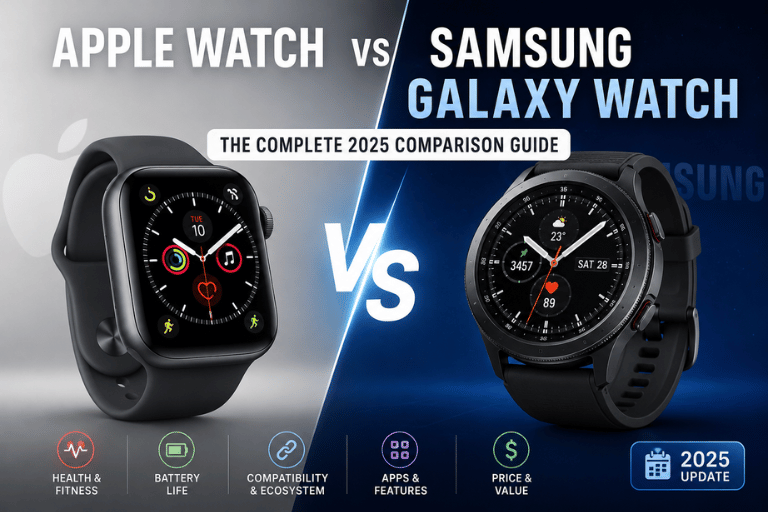
The smartwatch market in 2025 has, for most buyers, narrowed to a choice between two giants. Apple and Samsung dominate the premium segment with watches that have grown genuinely capable — not just as fitness trackers but as health monitoring devices, communication hubs, and wrist-worn extensions of your smartphone. Both companies update their lineups annually, and both have flagship models that represent the current state of the art for their respective ecosystems.
But here is the thing that most comparison articles bury in paragraph twelve: the smartphone you own is probably the most important factor in this decision, and it should settle the question before you even look at specs. Apple Watch does not work with Android phones at all. Samsung Galaxy Watch works with any Android phone, but loses a significant portion of its features — including Galaxy AI, body composition analysis, and the full Samsung Health suite — when paired with a non-Samsung Android device.
With that said, the ecosystem question is not the only one worth answering. Buyers of iPhone who want an Apple Watch, and buyers of Samsung Galaxy phones who want a Galaxy Watch, still face meaningful decisions about design, health features, battery life, and value. And for the minority who genuinely use both ecosystems or are considering a platform switch, a full comparison matters enormously.
This guide compares the Apple Watch Series 10 (Apple's current flagship standard model) against the Samsung Galaxy Watch 7 (Samsung's current standard flagship) — the two most directly comparable premium smartwatches from each company in 2025.
At a Glance: Who Each Watch Is For
| Apple Watch Series 10 | Samsung Galaxy Watch 7 | |
|---|---|---|
| Phone requirement | iPhone only | Any Android (best with Samsung Galaxy) |
| Design | Rectangular, flat OLED | Circular, AMOLED |
| Battery life | 18 hours typical | 40 hours typical |
| Unique health feature | Sleep Apnea detection | Blood pressure + Body composition |
| India starting price | ₹46,900 (42mm GPS) | ₹33,999 (40mm LTE) |
| Best for | iPhone users who want the tightest ecosystem integration | Android/Samsung users who want better battery and health breadth |
Design and Build: Rectangle vs Circle
This is the most immediately visible difference between the two watches, and it is worth discussing honestly — because it is a genuine split in philosophy, not just aesthetics.
Apple Watch Series 10
The Series 10 is Apple's thinnest Watch ever — 9.7mm at its slimmest, which is a 10% reduction over its predecessor. Apple has also expanded the screen area by approximately 30% compared to older models. The result is a watch that feels lighter and sits more comfortably on the wrist than any previous Apple Watch, addressing one of the most consistent criticisms of the line.
The rectangular face, which Apple has used since the original Watch in 2015, gives the display a larger usable area than a comparably sized circular watch — there are no unused corners. The OLED Retina display is sharp, with 2,000 nits peak brightness that remains readable in direct sunlight.
The Digital Crown — the physical rotary dial on the side — remains one of Apple Watch's most useful design choices. It gives precise scroll control without obscuring the screen with a finger. No other smartwatch has replicated it as effectively.
Aluminium case versions come in 42mm and 46mm sizes and are 50-metre water resistant (WR50). The frame material is aluminium, the back is ceramic, and the screen uses Ion-X glass — premium materials without the premium weight of the titanium option.
Samsung Galaxy Watch 7
The Galaxy Watch 7 takes the traditional round watch approach — which Samsung has maintained since the Galaxy Watch 4, when they moved away from the rotating bezel. The circular face makes the watch look more like a conventional watch in social situations — a meaningful consideration for professionals who wear dress watches and want their smartwatch to blend in similarly.
The display is a 1.3-inch (40mm) or 1.5-inch (44mm) Super AMOLED panel with a sapphire crystal protective layer on all models — something Apple reserves for its premium titanium variants. The sapphire crystal is meaningfully more scratch-resistant than the Ion-X glass on standard Apple Watch aluminium models.
The Galaxy Watch 7 is built to MIL-STD-810H certification alongside IP68 — a higher durability standard than the Apple Watch Series 10, which carries IP6X (dust resistance) but not a full IP68 water resistance rating. The Watch 7 is rated for submersion up to 5 metres, and carries 5ATM water resistance certification as well.
Design verdict: Round versus rectangular is a matter of personal preference that no spec sheet can resolve. The Galaxy Watch 7 looks more like a traditional watch; the Apple Watch Series 10 has a larger usable screen area for the same case size. The Galaxy Watch 7 has the more scratch-resistant screen. The Apple Watch has the Digital Crown. Pick your priority.
Display: What You See Every Day
| Apple Watch Series 10 (46mm) | Samsung Galaxy Watch 7 (44mm) | |
|---|---|---|
| Display type | OLED (Always-On) | Super AMOLED (Always-On) |
| Resolution | 496 × 416 px (383 PPI) | 480 × 480 px (453 PPI) |
| Peak brightness | 2,000 nits | 3,000 nits |
| Screen protection | Ion-X glass (aluminium) / Sapphire (titanium) | Sapphire crystal (all models) |
Both displays are excellent in daily use. The Galaxy Watch 7's higher pixel density (453 PPI vs 383 PPI) makes text and graphics marginally sharper up close. Its 3,000 nit peak brightness also exceeds the Apple Watch Series 10's 2,000 nits, which could matter in very bright outdoor conditions — though 2,000 nits is already more than sufficient for the vast majority of lighting situations.
Apple's OLED panel reproduces colours accurately and cleanly. Samsung's Super AMOLED tends toward slightly more vivid, saturated colours — which most people prefer subjectively, even if it is less technically accurate.
Performance: Chips and Speed
The Apple Watch Series 10 runs on the Apple S10 SiP (System in Package) — Apple's custom dual-core chip, purpose-built for watchOS. It is fast, tightly integrated with the operating system, and optimised for the specific workloads a smartwatch handles.
The Samsung Galaxy Watch 7 runs on the Exynos W1000 — Samsung's 3nm chip, the first 3nm processor in a consumer smartwatch. It is genuinely fast, drives the Wear OS interface smoothly, and enables the Galaxy AI features that Samsung has built into the Watch 7.
In day-to-day use, both watches are responsive and smooth. Neither will feel slow. The Apple S10 benefits from Apple's full-stack control over hardware and software; the Galaxy Watch 7's Exynos W1000 is a strong processor that supports the more complex on-device AI features Samsung has developed for health coaching and energy scoring.
Storage: Apple Watch Series 10 carries 64GB — meaningful for storing music, podcasts, and data. Galaxy Watch 7 has 32GB. The Apple Watch's larger storage is a genuine differentiator for users who want to stream or store music independently of their phone.
Health Tracking: Where the Real Differences Live
Both watches share a core set of health sensors: heart rate monitoring, ECG (electrocardiogram), blood oxygen (SpO2), skin temperature sensing, and GPS. The meaningful differences are where each company has chosen to go beyond this foundation.
Apple Watch Series 10 — Health Strengths
Sleep Apnea Detection is the headline health feature added in Series 10. This is Apple's first medically validated sleep apnea detection feature, which analyses breathing patterns during sleep over multiple nights and alerts users to potential signs of moderate to severe sleep apnea — a condition that affects a significant portion of the Indian population and is dramatically underdiagnosed. This feature is not available on the Galaxy Watch 7.
ECG monitoring on Apple Watch is widely regarded as the most reliable wrist-based ECG implementation available. The AFib (atrial fibrillation) detection has been cleared by health regulators in multiple countries and is clinically validated.
Crash Detection and Fall Detection are both present — the watch can automatically call emergency services if it detects a severe impact and the wearer is unresponsive.
Vitals app (watchOS 11) aggregates overnight health metrics — respiratory rate, heart rate, wrist temperature, blood oxygen, and sleep duration — into a single daily snapshot, making it easier to spot trends without digging through individual sensor apps.
Cycle tracking with temperature sensing helps detect ovulation patterns — a feature of genuine value for women tracking fertility or menstrual health.
Samsung Galaxy Watch 7 — Health Strengths
Blood Pressure Monitoring is the Samsung Galaxy Watch 7's most significant health differentiator in the Indian market. The feature is CDSCO (Central Drugs Standard Control Organisation) certified in India, making it one of the few wrist-based blood pressure monitors with regulatory clearance for use in the country. Hypertension is one of India's most prevalent chronic conditions — having an always-available BP monitor on the wrist has genuine health utility.
Important caveat: The blood pressure feature requires calibration against a standard arm-cuff blood pressure monitor every 28 days to maintain accuracy. It is not a substitute for clinical measurement. But for trend monitoring between medical appointments, it is a meaningful tool.
Body Composition Analysis via the BIA (Bioelectrical Impedance Analysis) sensor measures body fat percentage, skeletal muscle mass, and BMI using a weak electrical current through the skin. This is a feature Apple Watch does not offer. For users who actively track body composition — athletes, those in structured fitness programmes, or anyone managing metabolic health — this is a genuine Galaxy Watch advantage.
Advanced Sleep Tracking on the Galaxy Watch 7 is more granular than Apple Watch's implementation. It tracks snoring (via microphone), heart rate variability during sleep, blood oxygen dips, and breathing rate, and produces an Energy Score based on sleep quality, stress levels, and activity data. This score gives users an actionable summary of their readiness each morning.
Advanced Glycation End-products (AGE) Index — a newer Samsung Health feature that provides an estimate of long-term sugar exposure as a proxy for metabolic health — is available on the Galaxy Watch 7 with the Samsung Health app.
Galaxy AI Coaching provides guided workout plans, race tracking, post-workout recovery insights, and real-time coaching that goes beyond passive data logging. Apple Watch tracks workouts comprehensively but provides less active guidance.
Health Tracking Summary
| Feature | Apple Watch Series 10 | Samsung Galaxy Watch 7 |
|---|---|---|
| ECG | ✅ (clinically validated) | ✅ |
| Heart rate | ✅ | ✅ |
| Blood oxygen (SpO2) | ✅ | ✅ |
| Skin temperature | ✅ | ✅ |
| Fall detection | ✅ | ✅ |
| Crash detection | ✅ | ❌ |
| Sleep apnea detection | ✅ (medically validated) | ❌ |
| Blood pressure monitoring | ❌ | ✅ (CDSCO certified in India) |
| Body composition (BIA) | ❌ | ✅ |
| Advanced sleep coaching | Good | Better |
| Cycle tracking (temperature) | ✅ | ✅ |
| Workout types | 80+ | 90+ |
| GPS | ✅ (dual-frequency) | ✅ (dual-frequency) |
Battery Life: The Apple Watch's Most Persistent Weakness
This is the starkest spec difference between the two watches, and it remains genuinely relevant to daily life.
Apple Watch Series 10: Up to 18 hours of typical use. This is an improvement over older Series models, but it still means most users will charge it every night. Apple offers a Low Power Mode that extends to 36 hours, and a Saving Mode that reaches 72 hours — but these disable most active health tracking and smart features. Fast charging reaches 80% in approximately 30 minutes.
Samsung Galaxy Watch 7: Up to 40 hours of typical use. This means many users can go a full day and a half — or even two days with lighter usage — between charges. The practical implication: you can charge it every other night rather than every night, and you are less likely to run out on a long day away from a charger.
For sleep tracking specifically, this matters enormously. Wearing a watch while sleeping is how both devices track sleep quality and overnight health metrics. If you charge your Apple Watch overnight (as most do), you lose the sleep tracking data. Apple Watch users who want sleep data typically charge during their morning routine or evening wind-down period — which requires a habit change that many find easy to forget.
The Galaxy Watch 7's longer battery makes it significantly more practical for continuous sleep tracking without a behaviour change.
Operating Systems: watchOS vs Wear OS
watchOS (Apple Watch)
watchOS 11 (and the upcoming watchOS 26, announced at WWDC 2025 with a Liquid Glass design overhaul) is the most polished smartwatch operating system available. It integrates tightly with iPhone, iPad, and Mac. Siri on Apple Watch is fast and functional. The notification management, app ecosystem, and watch face customisation are all highly refined.
The App Store for watchOS has thousands of native apps — from banking apps to meditation apps to productivity tools. The overall software experience is smooth, consistent, and benefits from over a decade of iteration.
Limitation: watchOS is exclusively for iPhones. If you switch to Android, your Apple Watch becomes a paperweight.
Wear OS 5 with Samsung One UI Watch (Galaxy Watch 7)
Samsung's Galaxy Watch 7 runs Wear OS 5 — Google's smartwatch platform — with Samsung's One UI Watch overlay on top. The result is more capable than stock Wear OS, with Samsung Health deeply integrated and Galaxy AI features added on top.
The Google Play Store provides a large app ecosystem, though the native watchOS app catalogue remains deeper for some categories.
Limitation: While the Galaxy Watch 7 technically works with any Android phone, it loses features when used with non-Samsung devices. Paired with a Samsung Galaxy phone, it is excellent. Paired with a OnePlus, Pixel, or another Android brand, you lose body composition, Galaxy AI, blood pressure monitoring, and Energy Score — essentially its most differentiating features.
Ecosystem Integration: The Core Decision Factor
This deserves its own section because it is the factor that should, for most buyers, settle the choice.
If you use an iPhone: Apple Watch is your only genuine option. It integrates with iPhone at a system level — unlocking your Mac, Apple Pay, Handoff, iMessage, FaceTime audio from the wrist, emergency SOS, AirDrop, and the entire Apple ecosystem. Galaxy Watch pairs with iPhone but loses almost all its meaningful features.
If you use a Samsung Galaxy phone: Galaxy Watch 7 is the obvious choice. The full feature set — blood pressure, body composition, Galaxy AI, Energy Score — only functions paired with a Samsung Galaxy Android device. Apple Watch does not work with Samsung phones at all.
If you use a non-Samsung Android phone (OnePlus, Google Pixel, Motorola, etc.): Neither watch is ideal. Galaxy Watch 7 will pair but with reduced functionality. Apple Watch will not pair at all. A Pixel Watch or a Wear OS watch from another brand may serve you better in this scenario.
If you are considering switching phone ecosystems: Factor in that you will need to replace your watch if you switch from iPhone to Android or vice versa, unless you buy the Galaxy Watch 7 specifically.
India Pricing (2025–26)
| Model | India Price (MRP) |
|---|---|
| Apple Watch Series 10 (42mm, GPS) | ₹46,900 |
| Apple Watch Series 10 (46mm, GPS) | ₹49,900 |
| Apple Watch Series 10 (42mm, GPS + Cellular) | ₹56,900 |
| Samsung Galaxy Watch 7 (40mm, BT) | ₹29,999 |
| Samsung Galaxy Watch 7 (44mm, BT) | ₹33,999 |
| Samsung Galaxy Watch 7 (40mm, LTE) | ₹33,999 |
| Samsung Galaxy Watch 7 (44mm, LTE) | ₹39,999 |
Value note: The Galaxy Watch 7 is ₹13,000–₹17,000 cheaper than the Apple Watch Series 10 at comparable configurations — a meaningful gap. During sale seasons (Amazon Great Indian Festival, Flipkart Big Billion Days), the Apple Watch Series 10 has been available for as low as ₹31,999 with bank discounts, closing the gap somewhat.
For budget-conscious buyers who are iPhone users, the Apple Watch SE 3 (2025) starts at approximately ₹29,900 in India — offering core Apple Watch functionality (heart rate, GPS, fall detection, watchOS) at a Galaxy Watch 7-competitive price, without ECG, blood oxygen, or sleep apnea detection.
What Real Users Should Know
About the blood pressure feature on Galaxy Watch 7 in India: The blood pressure monitoring is CDSCO certified and functional in India — but requires calibration against a standard BP cuff every 28 days. Users who skip the calibration will get readings that drift in accuracy. It is a useful screening and trend-monitoring tool, not a clinical device. Do not use it to adjust medications or diagnose hypertension without doctor involvement.
About sleep tracking on Apple Watch: The most common complaint from Apple Watch users who switch to sleep tracking is that the 18-hour battery forces a charging habit change. The solution most users arrive at: charge for 30–45 minutes while getting ready in the morning, and wear the watch all day and all night. This works for most users but requires discipline to maintain.
About third-party apps: Both watches support third-party apps. Apple Watch has a larger catalogue of high-quality native watchOS apps. Galaxy Watch 7 relies partly on phone-based apps that mirror to the watch, which can be less smooth. If there is a specific app you care about — a banking app, a meditation app, a running coach — check whether it has a native watch version on your intended platform before buying.
About watchOS 26: Apple announced watchOS 26 at WWDC in June 2025, featuring a major visual redesign (Liquid Glass aesthetic), a new Workout Buddy feature, and expanded health insights. This will roll out to Series 10 users as a free update — a significant value addition to an already current-generation device.
The Verdict: Head-to-Head by Category
| Category | Winner |
|---|---|
| Design | Tie (personal preference) |
| Display quality | Galaxy Watch 7 (sapphire glass on all models; higher peak brightness) |
| Performance | Tie (both excellent) |
| Storage | Apple Watch Series 10 (64GB vs 32GB) |
| Battery life | Galaxy Watch 7 (40 hours vs 18 hours — decisive advantage) |
| Sleep apnea detection | Apple Watch Series 10 (not available on GW7) |
| Blood pressure monitoring | Samsung Galaxy Watch 7 (not available on Apple Watch) |
| Body composition | Samsung Galaxy Watch 7 (not available on Apple Watch) |
| ECG accuracy | Apple Watch Series 10 (more clinically validated history) |
| Sleep tracking depth | Samsung Galaxy Watch 7 (more granular coaching) |
| Ecosystem integration | Tie (depends entirely on your phone) |
| App ecosystem | Apple Watch Series 10 |
| India pricing | Samsung Galaxy Watch 7 (₹13,000–₹17,000 cheaper) |
| Durability (screen) | Samsung Galaxy Watch 7 (sapphire on all models) |
| Water resistance rating | Samsung Galaxy Watch 7 (IP68 vs IP6X) |
| Crash detection | Apple Watch Series 10 |
Final Recommendation
Buy the Apple Watch Series 10 if: You use an iPhone. Full stop. The ecosystem integration is so tight and so seamless — and the Apple Watch so exclusive to iPhone — that this is the simple answer for the majority of Indian smartphone users who are on iOS. The sleep apnea detection, the Crash Detection, the refined watchOS experience, and the future watchOS 26 update all make Series 10 an excellent purchase for any iPhone user.
Buy the Samsung Galaxy Watch 7 if: You use a Samsung Galaxy phone, and you want blood pressure monitoring, body composition tracking, and better battery life in a more affordable package. The Galaxy Watch 7 is a genuinely excellent watch for Samsung users, and at ₹30,000–₹40,000 in India, it is also better value than the Apple Watch at list price.
Consider the Apple Watch SE 3 if: You are an iPhone user who wants to spend Galaxy Watch 7-level money (approximately ₹30,000) and is comfortable without ECG, blood oxygen, and sleep apnea detection. The SE 3 delivers core Apple Watch functionality at the right price for first-time smartwatch buyers.
Consider the Samsung Galaxy Watch Ultra if: You are a serious athlete or endurance sports enthusiast on the Samsung ecosystem who needs maximum battery life, titanium durability, and advanced performance tracking — at a higher price point.
The answer to "which is better?" is almost always: whichever one works with your phone. The answer to "which has better health features?" depends on which specific health features you plan to actually use. And the answer to "which should I spend money on?" — well, you have enough information now to make that call yourself.
Prices reflect Indian market rates as of June 2026. Apple Watch Series 10 MRP from Apple India and Flipkart; Samsung Galaxy Watch 7 prices from Smartprix and Samsung India. Specifications from PhoneArena, GSMArena, and manufacturer spec sheets. Health feature regulatory clearances from CDSCO (India) and Apple's medical product pages. Prices and availability are subject to change.
