KZ Gale vs KZ EDX Pro: The Complete Guide to the Best Earphones Under ₹1,000
There is a moment that every budget audio enthusiast in India eventually experiences — the moment they put in a pair of well-tuned wired IEMs for the first time after years of using TWS earbuds and budget wireless headphones, and feel a quiet sense of revelation. The detail they had been missing. The bass that actually has texture rather than just volume. The vocals that sit in a specific place in the soundstage rather than floating vaguely somewhere in the middle of their head. The realization that the convenience premium they had been paying for wireless audio had come with a sound quality cost they did not know existed until it was gone.
The KZ Gale and KZ EDX Pro are the two earphones that most consistently produce this revelation moment for Indian listeners in 2026. Both cost under ₹1,000. Both use single dynamic drivers tuned with a level of care and technical competence that was simply unavailable at this price point five years ago. Both will, in pure sound quality terms, outperform most TWS earbuds under ₹3,000 and most budget wireless headphones under ₹2,000 in ways that are immediately audible rather than requiring trained ears to detect.
This guide is the most complete resource available for understanding both earphones — their technology, their sound, their specific strengths and weaknesses, how they compare to each other and to the wireless alternatives you currently own, and exactly which one you should buy based on how you actually listen.
Understanding Why Wired IEMs Beat Wireless at This Price Point
Before comparing the two earphones, understanding why they beat wireless alternatives at equivalent prices is important context — because the answer is not obvious and is frequently misunderstood.
The reason a ₹800 wired IEM outperforms a ₹2,000 TWS earbud in sound quality is not that wired connections are inherently magical. It is that TWS earbuds at any price point below ₹5,000 to ₹8,000 are spending the majority of their bill of materials on wireless technology, battery, touch controls, microphones, case charging electronics, and the complex software required to make all of these components work together reliably. The actual audio driver — the component that determines sound quality — receives whatever budget remains after all of these expensive components are paid for, which at the ₹1,500 to ₹3,000 price point is frequently very little.
A ₹800 wired IEM spends virtually its entire bill of materials on the audio driver, the acoustic chamber design, the cable, and the shell. There are no wireless chips, no batteries, no touch sensors, no charging cases to fund. The result is a driver quality and acoustic engineering standard that a TWS earbud at two to three times the price cannot match because it is spending its budget on different things.
This is not a criticism of TWS earbuds — their convenience advantages are real and valuable. It is simply an honest accounting of where the money goes at different price points, and why the comparison between a ₹800 wired IEM and a ₹2,000 TWS earbud in sound quality is not as unfair as the price difference suggests.
KZ as a Brand: Why It Matters and Why It Has Critics
KZ (Knowledge Zenith) is a Shenzhen-based audio manufacturer that has been making budget IEMs since 2014 and has become, by most measures, the most popular budget IEM brand in the world. They sell through AliExpress, Amazon, and Indian audio retailers at prices that routinely make established audio brands uncomfortable — not because KZ makes compromised products, but because they have industrialized the production of genuinely good-sounding IEMs at a scale and cost efficiency that larger brands struggle to match.
The criticism of KZ in audiophile communities is real and partially justified. The brand releases new models at a pace that is difficult to track, the quality control across their enormous product range is variable, and some of their products are significantly better than others in ways that are not obvious from the product listings. The KZ Gale and KZ EDX Pro are among the brand's best recent products — models where the driver quality, acoustic tuning, and build standard are all genuinely strong rather than merely adequate.
KZ also has a practice of releasing slight variants and successors of their popular models — the EDX Pro has been succeeded by the EDX Pro 2 in some markets, and the naming conventions can be confusing. This guide focuses specifically on the KZ Gale and the KZ EDX Pro as they are available in India in 2026, where both remain current and widely stocked.
The Technology: What Is Actually Inside These Earphones
Single Dynamic Driver Architecture
Both the KZ Gale and the KZ EDX Pro use a single dynamic driver — a moving coil transducer that converts electrical audio signal into sound through a vibrating diaphragm. This is the same fundamental technology used in premium audiophile IEMs costing ₹20,000 to ₹1,00,000, though the materials, tolerances, and acoustic engineering at the budget level are necessarily different.
The choice of a single dynamic driver rather than a multi-driver configuration (balanced armature drivers, or hybrid configurations combining dynamic and balanced armature) is a deliberate tuning philosophy at this price point. Single dynamic drivers produce bass through physical diaphragm movement in a way that balanced armature drivers — which dominate multi-driver budget IEMs — cannot, giving them a more natural, impactful low-end response that suits the V-shaped tuning both earphones use.
KZ's newer driver technology — used in both the Gale and the EDX Pro — represents a meaningful improvement over the company's earlier single dynamic drivers. The driver uses advanced diaphragm materials and a refined magnetic circuit that improves sensitivity, reduces distortion at higher volumes, and extends the frequency response at both ends compared to older KZ budget drivers. This technical improvement is audible — both earphones sound more refined and less congested at high volumes than their predecessors.
The Acoustic Chamber and Shell Design
The acoustic chamber — the enclosed space behind the driver that determines how bass reflects and accumulates before reaching the ear — is as important as the driver itself in determining the final sound character. The KZ Gale and EDX Pro use different shell geometries that contribute to their different sound signatures despite using similar driver technology.
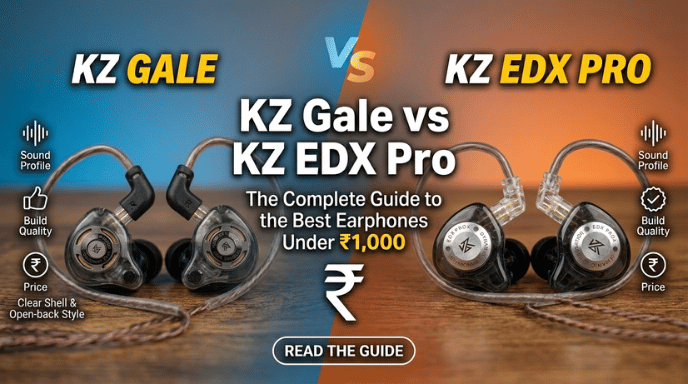
The KZ Gale's shell is larger and uses a design that KZ markets as gaming-focused — with a faceplate aesthetic reminiscent of gaming peripherals and an acoustic tuning that emphasizes the upper midrange and treble frequencies where gaming audio cues (footsteps, gunshots, directional sounds) are concentrated. The chamber geometry is tuned for a brighter, more forward sound that prioritizes detail and imaging over bass warmth.
The KZ EDX Pro's shell is more compact, with a clear body that shows the driver inside and a metal faceplate. The acoustic chamber tuning emphasizes the sub-bass region and achieves a warmer, more musical sound character that suits longer listening sessions for music. The more controlled treble response compared to the Gale makes it more forgiving of bright recordings — a meaningful practical advantage for listening to pop, Bollywood, and compressed streaming audio.
Sound Analysis: What Each Earphone Actually Sounds Like
KZ Gale — The Bright Detail Monster
The KZ Gale's sound signature is a V-shape with a specific character that distinguishes it from generic V-shape tuning: the bass emphasis is on mid-bass rather than sub-bass, and the treble lift is placed in the upper midrange and lower treble region rather than the extreme high frequencies. This placement has specific auditory consequences that determine which listeners and which music genres the Gale suits best.
Bass: The Gale's mid-bass emphasis produces bass that is felt as impact and punch rather than as depth and rumble. A kick drum sounds punchy and immediate. A bass guitar has presence and articulation. Sub-bass extension — the deep, physical rumble of electronic bass below 60Hz — is present but not emphasized, meaning that bass-heavy electronic music like EDM and trap sounds energetic rather than earth-shaking. For listeners accustomed to bass-boosted TWS earbuds that emphasize sub-bass for perceived loudness, the Gale's bass might initially seem less impressive before revealing its superior texture and detail.
Midrange: The Gale's midrange is slightly recessed relative to the bass and treble — characteristic of V-shape tuning — but retains enough presence for vocals to remain intelligible and emotionally engaging. Male vocals have adequate body. Female vocals sit slightly forward in the mix, benefiting from the treble lift that gives them clarity and air. The midrange recession means the Gale is not the ideal choice for genres where vocal intimacy is the primary listening priority.
Treble: This is the Gale's most distinctive characteristic and its most divisive. The upper midrange and lower treble lift gives instruments and vocals a bright, airy, detailed quality that reveals micro-detail in recordings — the breath before a vocal phrase, the subtle room reverb on a piano recording, the click of a guitar pick on strings. For detail-hungry listeners and gamers who need to hear high-frequency spatial cues, this brightness is a significant advantage. For listeners sensitive to treble harshness — those who find bright headphones fatiguing after thirty to sixty minutes — the Gale's treble can be irritating on certain recordings, particularly compressed streaming audio or older recordings with prominent sibilance.
Soundstage and imaging: The Gale's most technically impressive characteristic is its imaging — the precision with which it places sounds in three-dimensional space. For an earphone at this price, the Gale's ability to create a convincing sense of instrument separation and directional specificity is remarkable. This is not primarily a function of wide soundstage (the Gale's soundstage width is moderate) but of precise placement within the stage — sounds are located at specific points rather than floating vaguely left or right. This precision is the technical characteristic that makes the Gale particularly effective for gaming, where directional audio cues are gameplay-critical information rather than aesthetic preference.
KZ EDX Pro — The Musical All-Rounder
The KZ EDX Pro's sound signature is also a V-shape, but voiced toward the warmer, more musical end of the V-shape spectrum. Where the Gale chases detail and imaging precision, the EDX Pro prioritizes tonal balance and listening fatigue resistance — qualities that make it more enjoyable for long music listening sessions across a wider range of genres.
Bass: The EDX Pro's sub-bass emphasis produces a low-end character that is qualitatively different from the Gale's mid-bass focus. Sub-bass extension — the physical, felt quality of deep bass — is significantly stronger on the EDX Pro, making electronic music, hip-hop, and bass-heavy Bollywood production more viscerally satisfying. The bass is well-controlled for the price — it does not bleed excessively into the midrange, maintaining the clarity of the overall sound even when bass-heavy tracks are playing. For listeners coming from bass-boosted TWS earbuds, the EDX Pro's sub-bass extension will feel more familiar while delivering significantly better texture and definition.
Midrange: The EDX Pro's midrange is more present than the Gale's — slightly less recessed in the V-shape — giving vocals more body and instruments more natural tonal weight. Acoustic guitar sounds fuller. Vocals have more chest resonance in the lower midrange. The overall character is warmer and more organic than the Gale's brighter presentation. For genres where vocal performance is central — classical Indian music, ghazals, acoustic folk, slow Bollywood — the EDX Pro's midrange presentation is significantly more emotionally engaging.
Treble: The EDX Pro's treble is more controlled and smoother than the Gale's — present enough for detail and air without the forward brightness that can fatigue sensitive listeners. High-frequency cymbals have shimmer without harshness. Vocal sibilance (the 's' and 'sh' sounds that can become irritating on bright earphones) is managed better on the EDX Pro than on the Gale. This treble character makes the EDX Pro more forgiving of imperfect recordings and compressed streaming audio — which constitutes the majority of what most listeners actually hear on a daily basis.
Soundstage and imaging: The EDX Pro's soundstage is slightly wider than the Gale's, creating a more spacious, open feeling to the music. The imaging precision is good but behind the Gale — sounds are placed with reasonable accuracy but without the pinpoint specificity that the Gale achieves. For music listening, this difference is rarely significant — the wider, more enveloping presentation of the EDX Pro actually suits most music better than the Gale's precise but narrower stage. For gaming, where precise directional imaging matters, the Gale's advantage here is meaningful.
Head-to-Head: Genre by Genre
EDM and Electronic Music
EDX Pro wins. The sub-bass extension and impact that EDM requires is better served by the EDX Pro's bass tuning. The Gale sounds energetic but slightly thin in the low end on bass-heavy electronic tracks.
Hip-Hop and Trap
EDX Pro wins. Sub-bass weight and mid-bass punch together create the low-end presence that defines hip-hop and trap production. The EDX Pro delivers both more convincingly.
Bollywood
Tie, depends on era. For contemporary Bollywood with heavy bass production (most post-2015 tracks), the EDX Pro's warmer tuning suits better. For older Bollywood with prominent vocals and acoustic instruments, the Gale's detail and vocal clarity serve better.
Rock and Metal
Gale wins. The Gale's bright treble and precise imaging make guitars, cymbals, and the spatial complexity of rock and metal recordings more engaging. The EDX Pro can sound slightly thick and congested on complex rock arrangements.
Classical and Acoustic
EDX Pro wins. The natural tonal weight of the EDX Pro's midrange suits acoustic instruments — violin, tabla, sitar, piano — far better than the Gale's brighter presentation, which can make acoustic instruments sound slightly harsh.
Carnatic and Hindustani Classical
EDX Pro wins clearly. The vocal-forward, tonally accurate character of the EDX Pro suits Indian classical music deeply. The warmth and midrange presence make veena, sarod, and vocal performances emotionally resonant in a way the brighter Gale does not match.
Gaming
Gale wins clearly. The imaging precision advantage of the Gale is significant for competitive gaming — footsteps, directional cues, and spatial positioning are notably more accurate than on the EDX Pro. The brighter treble also makes high-frequency game audio cues (reload sounds, distant gunshots, environmental audio) more audible.
Podcast and Spoken Word
EDX Pro wins. The natural vocal reproduction and fatigue-resistant treble make the EDX Pro significantly more comfortable for hours of podcast and audiobook listening.
Build Quality and Comfort: The Practical Reality
Both earphones share several build characteristics — lightweight plastic shells, detachable cables using KZ's QDC connector system, and the same basic accessory package of silicone ear tips in three sizes and a basic cable.
The shared limitations at this price point are honest rather than surprising. The stock cables are thin, tangle-prone, and develop memory (persistent kinks) with regular use. Neither earphone comes with a carrying case. The ear tips are functional but not exceptional — the stock KZ Starline silicone tips seal adequately but do not optimize the sound of either earphone.
The KZ Gale's shell has a slight design quirk worth noting: a circular ridge on the inner shell surface can catch on ear hairs and cause mild irritation during insertion and removal, particularly for listeners with hair in the ear canal. This is a minor build detail that a small percentage of users find annoying enough to mention consistently in reviews. The EDX Pro's shell is smoother and less likely to cause this issue.
Both earphones use an over-ear cable routing — the cable loops over the top of the ear before going to the earphone — which significantly improves stability and reduces the cable movement noise (microphonics) that in-ear earphones with straight-down cables suffer from. This over-ear fit is standard in the IEM world and is one of the reasons well-fitted IEMs stay in place during exercise and movement better than most TWS earbuds.
The detachable cable is one of both earphones' most practically valuable features. When the cable eventually wears out — as cables always do — replacing it costs ₹150 to ₹500 for an aftermarket cable rather than the full cost of the earphone. KZ upgrade cables in silver-plated copper or pure copper are available on Amazon India and provide a marginal sound quality improvement alongside better build durability than the stock cable.
The Upgrade Tip Advice: Unlocking Both Earphones' Full Potential
The single most impactful and most affordable upgrade for both earphones is replacing the stock ear tips with aftermarket alternatives. The stock KZ Starline tips are functional but leave meaningful performance on the table — particularly in bass extension and noise isolation, both of which depend heavily on ear tip material, shape, and seal quality.
For improved bass and isolation: Foam ear tips (KZ's own memory foam tips are available for approximately ₹150 to ₹200 on Amazon India) create a significantly better seal than silicone tips for most ear shapes, improving sub-bass extension and passive noise isolation by a meaningful amount. The trade-off is slightly reduced treble airiness and the need to replace foam tips every two to three months as they compress and lose their seal.
For improved detail and soundstage: Wide-bore silicone tips (JVC Spiral Dot copies at ₹200 to ₹400, or NiceHCK C04 tips at ₹300 to ₹500) open the soundstage slightly and improve treble extension on both earphones. The wider bore allows more high-frequency energy to reach the ear, suiting the Gale's detail-forward tuning particularly well.
The total cost of the aftermarket tip upgrade is ₹150 to ₹500 — less than the price difference between the two earphones — and produces a clearly audible improvement in the performance of either model.
Which Earphone Beats Your Current Gear: The Honest Comparison
vs. TWS Earbuds Under ₹2,000 (boAt Airdopes, Realme Buds, Noise Buds, JBL entry-level)
Both the Gale and EDX Pro beat these clearly in sound quality. The dynamic driver in both KZ earphones is better quality and more carefully tuned than the drivers in most TWS earbuds at this price. The lack of Bluetooth compression means the audio signal reaches the driver without the lossy encoding that degrades TWS audio quality. Bass is tighter and more textured, midrange is more natural, and treble is more detailed on either KZ than on most TWS earbuds at equivalent or higher prices.
What you give up: no wireless convenience, no ANC, no touch controls, no call mic on the standard version (the mic version adds approximately ₹100 to ₹200).
vs. Budget Wireless Headphones Under ₹2,000 (JBL C45BT, Boult Audio, Zebronics)
The comparison here depends on the specific headphone, but generally: both KZ earphones match or beat these headphones in detail, imaging, and treble clarity. The headphones win in bass quantity (larger drivers move more air) and in soundstage width (over-ear designs create more physical space). Whether the KZ earphones beat the headphones in sound quality overall depends on what you prioritize — bass quantity (headphones win) or detail, imaging, and tonal accuracy (KZ earphones win).
vs. TWS Earbuds ₹2,000 to ₹4,000 (Samsung Galaxy Buds FE, Nothing Ear 2, OnePlus Buds Pro)
This comparison is more honest. These TWS earbuds have better driver quality and tuning than entry-level wireless. The Nothing Ear 2 and Samsung Galaxy Buds FE in particular have genuinely competitive sound quality. The KZ earphones still win on pure sound quality in most comparisons, but the gap is meaningfully smaller. At this price range, the wireless convenience, ANC functionality, and call quality of premium TWS starts to make a more compelling case against the wired alternative.
Buying Guide: India-Specific Advice
Where to Buy
Both earphones are available on Amazon India, Flipkart, and specialty audio retailers. Amazon India pricing as of mid-2026:
KZ Gale: ₹699 to ₹899 depending on variant (no mic, with mic, or USB-C with mic) KZ EDX Pro: ₹599 to ₹799 depending on variant
Avoid purchasing from unofficial resellers at significantly different prices — KZ earphones have been counterfeited, and anomalously low prices on unofficial platforms are a warning sign. Amazon's fulfilled listings from KZ's official India store are the safest purchase.
Which Variant to Buy
Both earphones come in three variants — no mic (for pure audio use), 3.5mm with inline mic (for calls), and USB-C with inline mic (for phones without a headphone jack). The USB-C variant costs approximately ₹100 to ₹150 more but is the most practical choice for OnePlus, Samsung Galaxy, and Pixel users whose phones lack a 3.5mm jack. For phones with 3.5mm (most budget and mid-range Indian smartphones retain the jack), the standard 3.5mm with mic variant is the most versatile option.
The Final Recommendation
Buy the KZ Gale if you game on your phone or PC, you listen to rock and electronic music, you prioritize detail retrieval over warmth, or you specifically want a brighter, more energetic sound signature.
Buy the KZ EDX Pro if you primarily listen to music across varied genres, you value vocal quality highly, you listen for long sessions and prefer a fatigue-free experience, or your music library is heavily weighted toward Bollywood, classical, hip-hop, or acoustic genres.
If you genuinely cannot decide — both earphones cost less than ₹900, and buying both for under ₹1,600 total gives you the gaming specialist and the music generalist in a package that covers every listening scenario. Keep the one you prefer and gift the other. At these prices, the cost of trying both is less than a single meal at a mid-range restaurant.
Either way, the moment you put them in and press play, you will understand immediately why the budget IEM community has been so loud about these earphones — and why your TWS earbuds will feel noticeably less impressive afterward.
