Are Budget Smartwatches Accurate? The Honest Answer Backed by Testing
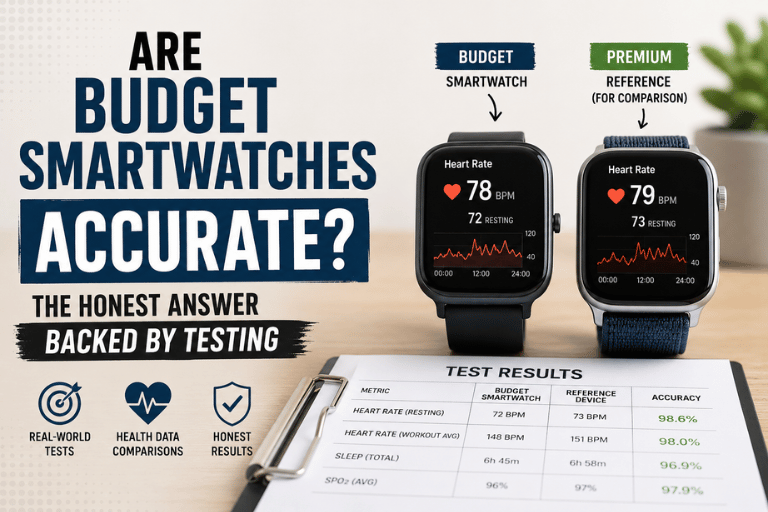
The budget smartwatch market has exploded in India and globally over the past five years. Devices that cost ₹2,000 to ₹5,000 now arrive with specifications that would have seemed implausible at that price point a decade ago — heart rate monitoring, SpO2 sensors, sleep tracking, GPS, stress measurement, menstrual cycle tracking, VO2 max estimation, and ECG capabilities are all features that appear regularly on budget smartwatch marketing materials regardless of whether the underlying hardware and software can actually deliver them reliably.
This disconnect between the feature lists on budget smartwatch packaging and the actual accuracy of those features in real-world use is one of the most persistent and consequential gaps in consumer electronics right now. People are making genuine health decisions based on data from these devices — adjusting medication timing based on heart rate alerts, monitoring blood oxygen levels during illness, tracking sleep to address fatigue, training for marathons using pace and distance data from GPS. If that data is substantially inaccurate, the consequences range from mildly misleading to genuinely dangerous.
This guide examines each major smartwatch feature category honestly — what the underlying technology actually is, how budget devices implement it compared to premium alternatives, what research and real-world testing shows about accuracy, and which features are reliable enough to act on versus which should be treated as rough estimates or ignored entirely.
Understanding What "Accurate" Means for Smartwatches
Before evaluating accuracy, it is worth establishing what accuracy means in the context of wearable health monitoring — because the standard is different for different features and different use cases.
For step counting, accuracy of plus or minus 10% in daily totals is generally considered acceptable for motivational health tracking. For heart rate during exercise, accuracy within plus or minus 5 beats per minute is clinically meaningful. For SpO2 (blood oxygen saturation), accuracy within plus or minus 2 to 3 percentage points is the standard that medical devices must meet — and values below 95% that trigger a clinical response need to be significantly more reliable than values that simply appear on a wellness dashboard.
The critical distinction is between absolute accuracy (how close the reading is to the true physiological value) and trend accuracy (how well the device tracks changes over time relative to itself). A device that consistently reads heart rate 8 beats per minute higher than actual may still be useful for tracking whether your resting heart rate is trending up or down over weeks, even if the absolute number cannot be trusted for clinical purposes. Understanding which type of accuracy a budget device achieves helps you use its data appropriately.
Heart Rate Monitoring: The Most Used and Most Misleading Feature
Heart rate monitoring is the feature that most directly affects how people use their smartwatches in daily life — for exercise intensity guidance, stress monitoring, sleep analysis, and general health awareness. It is also the feature where the gap between premium and budget devices is most clearly documented by independent research.
How Photoplethysmography (PPG) Works
All consumer smartwatches — budget and premium alike — measure heart rate using photoplethysmography (PPG), a technology that shines green LED light into the skin and measures the variation in light absorption as blood pulses through capillaries with each heartbeat. The variation in reflected light corresponds to the pulse wave, from which heart rate is calculated.
The quality of this measurement depends on several factors that budget devices frequently compromise on: the quality and positioning of the LED array, the quality of the photodetector that captures reflected light, the pressure exerted on the skin by the watch case (affecting contact quality), and the sophistication of the signal processing algorithms that interpret the raw optical data and filter out noise from movement.
What Research Shows About Budget vs. Premium Heart Rate Accuracy
Academic research consistently shows significant accuracy differences between budget and premium devices for heart rate monitoring, with the gap widest during exercise and narrowest at rest.
At rest and during light activity, many budget smartwatches perform reasonably well — studies comparing budget devices against medical-grade chest ECG monitors find that resting heart rate measurements from decent budget watches are typically within 5 to 8 beats per minute of the true value for most wearers under sedentary conditions. This is adequate for general awareness but not for clinical use.
During moderate to vigorous exercise — the conditions under which most people want accurate heart rate data for training purposes — budget device accuracy degrades substantially. The problem is motion artifact: the mechanical vibration and movement of the wrist during exercise creates optical noise that the relatively simple signal processing algorithms in budget devices cannot reliably filter. Premium devices use more sophisticated algorithms, multi-wavelength LED arrays, and better contact geometries to address this problem with considerably more success.
Studies on budget smartwatches during cycling, running, and HIIT exercise have found mean absolute errors of 10 to 25 beats per minute compared to chest-based ECG reference measurements — errors significant enough to meaningfully misrepresent exercise intensity zones. A runner targeting 75% of maximum heart rate for aerobic training could be working at 65% or 85% based on a budget device's reading, with genuinely different physiological consequences.
Skin Tone and Heart Rate Accuracy: An Important and Underreported Issue
Research published in multiple peer-reviewed journals has documented that PPG-based heart rate monitors are systematically less accurate on darker skin tones — a finding with particular relevance for Indian consumers. The green LED wavelength used in most smartwatch heart rate sensors is absorbed more by melanin at higher concentrations, reducing the signal-to-noise ratio of the optical measurement and degrading accuracy.
Premium manufacturers have invested in multi-wavelength LED arrays (adding red and infrared wavelengths that are less affected by melanin) and skin-tone-adaptive algorithms to partially address this bias. Budget devices almost universally use simple green-only LED arrays without adaptive algorithms, meaning that the accuracy gap between budget and premium is even wider for Indian skin tones than headline research numbers (which often use predominantly lighter-skinned test populations) suggest.
This is not a trivial concern. If you are using a budget smartwatch to monitor your heart rate for health reasons, and your skin tone is medium to deep brown, you should apply additional skepticism to the readings and avoid treating them as clinically meaningful data.
Practical Verdict on Budget Heart Rate Monitoring
Use budget heart rate data for general trend awareness over time — whether your resting heart rate is stable, increasing, or decreasing week to week — rather than for real-time exercise intensity guidance or clinical health monitoring. For serious athletic training, a chest strap heart rate monitor (Polar H10 at approximately ₹4,500 to ₹6,000) provides dramatically better real-time accuracy than any wrist-based monitor at any price point.
SpO2 (Blood Oxygen Saturation): Treat With Significant Caution
SpO2 monitoring became the most aggressively marketed budget smartwatch feature during and after the COVID-19 pandemic, when blood oxygen saturation monitoring moved from clinical obscurity to mainstream health awareness in a matter of months. Budget devices rushed to add SpO2 sensors, and the feature now appears on virtually every smartwatch sold above ₹1,500.
How SpO2 Sensing Works in Smartwatches
Medical pulse oximeters measure SpO2 by shining two wavelengths of light — red (660nm) and infrared (940nm) — through tissue (typically a fingertip) and measuring how much of each is absorbed. Oxygenated and deoxygenated hemoglobin absorb these wavelengths differently, and the ratio of absorption provides a highly accurate measurement of blood oxygen saturation. Certified medical pulse oximeters must achieve accuracy within ±2 percentage points across a range of 70% to 100% SpO2 to receive regulatory approval.
Smartwatch SpO2 sensors attempt a similar measurement from the wrist, using reflected rather than transmitted light — a fundamentally less accurate measurement geometry because the optical path through the wrist is shorter, more variable, and subject to more motion artifact than the fingertip. Even premium smartwatch manufacturers acknowledge that their SpO2 readings should not be used for clinical decisions and are intended as wellness indicators rather than medical measurements.
Budget SpO2 Accuracy: The Research Is Damning
Independent testing of budget smartwatch SpO2 sensors against certified medical pulse oximeters has consistently found that budget devices are not reliable for detecting clinically significant hypoxemia (low blood oxygen). Studies have found mean absolute errors of 3 to 8 percentage points compared to reference measurements, with individual readings sometimes differing by 10 or more percentage points.
The clinical significance of this is substantial. A true SpO2 of 91% — a level that warrants medical attention — might read as 96% or 98% on a budget device, providing false reassurance. Conversely, a normal SpO2 of 97% might read as 93% on a bad measurement, causing unnecessary anxiety.
The most comprehensive independent study of consumer smartwatch SpO2 accuracy, published in the British Medical Journal, found that even premium devices from major manufacturers failed to meet the accuracy standards required of medical pulse oximeters across the full range of skin tones. For budget devices, accuracy was significantly worse, and the authors explicitly warned against using consumer smartwatch SpO2 data for health decisions.
The Motion Problem
Unlike resting heart rate measurement, SpO2 measurement requires a longer, stationary measurement window to produce a reliable reading. Budget devices that display continuous SpO2 readings are almost certainly producing unreliable data during anything other than complete stillness — the motion artifact in a moving wrist overwhelms the relatively weak signal from the reflective measurement geometry.
Practical Verdict on Budget SpO2
Do not rely on budget smartwatch SpO2 readings for any health decision, under any circumstances. If you have a genuine clinical need to monitor blood oxygen saturation — asthma, COPD, sleep apnea, post-COVID monitoring, altitude sickness prevention — use a certified fingertip pulse oximeter. Reputable brands like Dr. Trust, Beurer, and Contec offer validated fingertip pulse oximeters in the ₹1,500 to ₹3,000 range that meet actual medical accuracy standards. A budget smartwatch SpO2 reading should be treated as entertainment data, not health data.
GPS Accuracy: A Tale of Two Technologies
GPS is the feature where the budget versus premium divide is most technically stark — because the fundamental hardware difference is not merely about sensor quality but about the type of GPS technology implemented.
Assisted GPS vs. Standalone GPS vs. No GPS
Many budget smartwatches marketed with "GPS" or "GPS tracking" features actually use connected GPS — they borrow the GPS signal from your paired smartphone rather than having an independent GPS receiver. This means the watch displays GPS-based distance and pace data, but only when you carry your phone. Without your phone, the watch reverts to accelerometer-based step counting to estimate distance — which is significantly less accurate, particularly for activities like cycling.
Standalone GPS — an independent GPS receiver built into the watch itself — is present in a smaller number of budget devices and is genuinely present in most devices priced above ₹5,000 to ₹8,000 from brands like Amazfit, Noise, and boAt that have invested in the hardware. Standalone GPS accuracy for distance and pace tracking is considerably better than accelerometer estimation, but budget GPS chipsets (typically single-band L1 GPS) are meaningfully less accurate than the multi-band GNSS receivers in premium watches from Garmin, Apple, and Samsung.
Dual-band GNSS — which reads both L1 and L5 GPS frequencies and combines data from multiple satellite networks (GPS, GLONASS, Galileo, BeiDou) — is found in premium fitness watches starting from approximately ₹20,000 to ₹25,000. Dual-band GNSS achieves position accuracy of approximately 2 to 3 meters under open sky conditions and degrades much less significantly in urban canyons, dense tree cover, and complex terrain than single-band GPS.
Budget GPS Performance in Real-World Testing
Independent testing of budget smartwatch GPS for running and cycling shows that single-band GPS budget devices produce route accuracy adequate for basic outdoor fitness tracking under open-sky conditions — typical distance measurement errors of 1 to 5% compared to validated GPS reference devices. For a 10km run, this means the device might report 9.7km to 10.5km, which is acceptable for general fitness tracking.
Performance degrades substantially in:
Urban environments with tall buildings that block satellite signals (GPS multipath error) — budget single-band GPS in Mumbai, Delhi, or Bengaluru city centers can show significant route distortions and distance errors of 10% or more.
Dense forest or mountain terrain where satellite visibility is compromised — popular with hikers and trail runners in Himalayan destinations where precise navigation matters.
Wrist-mounted GPS during cycling — the wrist position creates additional satellite blockage compared to GPS devices mounted on the bike or worn on the arm, and budget chipsets are more sensitive to this effect.
Practical Verdict on Budget GPS
If you are running or cycling in open suburban or park environments and primarily want to track approximate distance and route for general fitness awareness, budget standalone GPS is adequate. If you train in cities, dense terrain, or require accurate pace data for competitive training, the investment in a mid-range to premium GPS watch is justified by meaningfully better accuracy.
Verify before purchasing whether a specific budget watch uses standalone GPS or connected GPS — the marketing language is frequently ambiguous or misleading on this point. Check the device's specifications for language like "built-in GPS" versus "connected GPS" or "GPS via phone."
Step Counting: The Most Accurate Budget Feature
Step counting is where budget smartwatches perform most respectably relative to research-grade reference devices, and it is where the accuracy gap between budget and premium devices is smallest. The technology — a 3-axis accelerometer — is relatively inexpensive, mature, and consistent across price points. The significant performance variable is the algorithm that interprets accelerometer data and distinguishes genuine walking and running steps from other wrist movements.
Research comparing budget smartwatches against research-grade pedometers and direct observation counting consistently finds that budget devices achieve step count accuracy within 10 to 20% of true step counts during level walking on smooth surfaces. Most devices systematically overcount steps during activities involving wrist movement without forward ambulation (cooking, driving, typing) and undercount during activities with unusual gait patterns (slow walking, walking on uneven terrain, walking with a shopping bag in the non-watch hand).
The practical implication is that budget smartwatch step counts are meaningful for tracking relative daily activity trends — whether you are more or less active than yesterday or last week — but should not be treated as precise absolute measurements. The popular target of 10,000 steps per day is already an arbitrary wellness goal rather than a clinically validated threshold, which means that step count accuracy within 15% is sufficient for its primary motivational purpose.
Sleep Tracking: Interesting Data, Significant Limitations
Sleep tracking is among the most eagerly used features on budget smartwatches and the one where accuracy limitations are most consequential if the data is taken seriously rather than as rough guidance.
Consumer smartwatch sleep tracking uses a combination of accelerometer data (movement reduction indicates sleep onset and depth) and, in more sophisticated implementations, heart rate variability data to estimate sleep stages — light sleep, deep sleep, and REM sleep. The gold standard for sleep stage measurement is polysomnography (PSG), conducted in a clinical sleep laboratory with EEG electrodes directly measuring brain wave activity.
Research comparing consumer smartwatch sleep stage detection against PSG consistently finds that wrist-based devices are reasonably accurate at detecting total sleep time (within 30 minutes for most nights) and sleep onset, but significantly inaccurate at sleep stage classification. Studies find that budget smartwatches correctly classify sleep stages approximately 50 to 65% of the time — a meaningful improvement over random chance but far from reliable enough to draw clinical conclusions about sleep architecture.
The practical consequence is that budget smartwatch sleep data is useful for tracking sleep duration trends and identifying nights of significantly disrupted sleep, but the specific breakdown of "45 minutes of deep sleep" versus "62 minutes of deep sleep" is not measurement — it is an educated algorithm guess that should not be acted upon without corroboration from how you actually feel.
ECG and Advanced Health Features: Marketing More Than Medicine
Several budget smartwatches now advertise ECG (electrocardiogram) capabilities — the ability to detect heart rhythm irregularities including atrial fibrillation. This feature warrants extreme caution.
Medical ECG requires multiple leads (electrode positions) that measure electrical activity across the heart from different angles. Consumer smartwatch ECG uses a single-lead measurement — the electrical signal from your finger touching a sensor on the watch case — that can detect certain rhythm irregularities but has significant sensitivity and specificity limitations compared to clinical ECG.
Even the Apple Watch's ECG feature, which is FDA-cleared for single-lead ECG and atrial fibrillation detection, explicitly states it cannot detect all types of arrhythmia, cannot detect heart attacks, and should not be used to replace medical evaluation. The ECG features on budget smartwatches typically are not cleared by any regulatory body (not FDA, not CE, not India's CDSCO) and their algorithms have not been independently validated in peer-reviewed research.
The risk of both false positives (alerting users without actual arrhythmia, causing anxiety and unnecessary medical visits) and false negatives (missing genuine arrhythmia, providing false reassurance) makes budget smartwatch ECG data actively potentially harmful if acted upon without medical confirmation. If you have genuine concerns about cardiac arrhythmia, the appropriate response is a consultation with a cardiologist who will use validated clinical equipment — not a ₹3,000 smartwatch.
Which Budget Brands Perform Best: A Relative Ranking
Within the budget segment, accuracy performance varies significantly by brand — primarily because of investment in algorithm quality rather than sensor hardware.
Amazfit (owned by Zepp Health, formerly Huami) consistently outperforms other budget brands in heart rate and GPS accuracy testing. The brand benefits from significant R&D investment relative to its price points, a substantial database of biometric data used to train its algorithms, and genuine engineering attention to sensor performance. The Amazfit Band 7, Bip 5, and GTR Mini are consistently among the best-performing budget health trackers in independent accuracy comparisons.
Fitbit's entry-level devices (Inspire series) maintain the accuracy heritage of the Fitbit brand with relatively reliable heart rate and step counting, though Fitbit's lower presence in the Indian market at truly budget price points limits their accessibility.
Noise, boAt, and Fire-Boltt — the dominant Indian budget smartwatch brands — show highly variable accuracy that differs significantly between models and firmware versions. These brands prioritize feature breadth and aesthetic design over sensor accuracy, and independent testing frequently finds that their heart rate and SpO2 readings are less reliable than Amazfit equivalents at similar price points.
Realme and Oneplus Band devices perform reasonably in step counting and basic heart rate monitoring, with accuracy competitive with Amazfit at similar price points.
The Honest Bottom Line: What Budget Smartwatches Are Actually Good For
After reviewing the research, testing data, and underlying technology across feature categories, a realistic picture of budget smartwatch utility emerges that is more nuanced than either the enthusiastic marketing or the dismissive criticism suggests.
Reliably useful: Step count trends, sleep duration tracking, notification management, timer and alarm functions, resting heart rate trends over time (not absolute values), general activity motivation through goal-setting and streaks.
Useful with appropriate skepticism: Exercise heart rate during low-intensity activity, GPS distance tracking in open environments, sleep quality trends over weeks and months, calorie estimates as rough order-of-magnitude guidance rather than precise measurements.
Not reliable enough for health decisions: SpO2 readings, ECG and arrhythmia detection, VO2 max estimates, stress scores, blood glucose estimates (on the rare budget devices claiming this), exercise heart rate during vigorous activity, sleep stage breakdowns.
The budget smartwatch is a genuinely excellent motivational and lifestyle tool — a device that makes you more aware of your activity levels, sleep duration, and general health trends, and that through this increased awareness nudges behavior in positive directions. Fitness tracking research consistently shows that the act of tracking activity, regardless of tracking precision, is associated with increased physical activity and improved health behaviors.
Where budget smartwatches fail is when they are treated as medical devices rather than wellness motivators — when their SpO2 readings influence decisions about seeking medical attention, when their ECG outputs are used to assess cardiac health, or when their heart rate zones are used to structure precision athletic training.
Use a budget smartwatch for what it actually does well — and for everything else, know its limits.
