Soundcore Space 2 Review: Jet Noise Silenced, First-Class Comfort Delivered
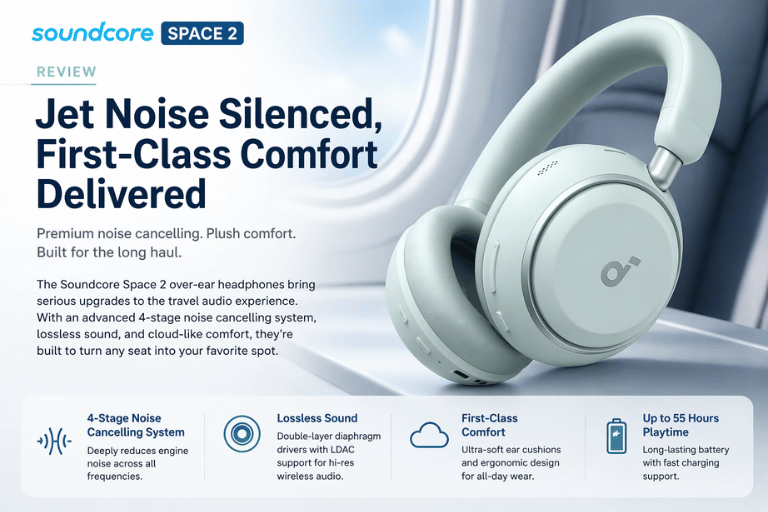
Soundcore Space 2 review — featuring Adaptive ANC 3.0, 70H battery, LDAC, and all-day comfort at $129.99. Everything you need to know before buying.
The Travel Headphone Problem Nobody Talks About Honestly
Here's what nobody tells you about budget noise-cancelling headphones.
They work fine on YouTube comparisons and in quiet rooms. Then you board a flight, put them on, and realize that the ANC that sounded impressive in a controlled demo barely takes the edge off a real jet engine. The ear cups that felt comfortable for 20 minutes in a store become pressure points after two hours in the air. The battery that claimed 30 hours lasts 18 with ANC on. And the case that was described as "travel-ready" turns out to be a rigid block that takes up a third of your carry-on.
The premium ANC headphone market has largely solved these problems — if you're willing to spend $300–$400 on Sony XM5s or Bose QuietComfort Ultras. But the gap between premium and budget ANC has historically been enormous, and the $100–$150 category has been populated by products that make impressive spec-sheet claims and disappoint in actual use.
The Soundcore Space 2 — launched in April 2026 at $129.99 — is Soundcore's entry into the serious travel headphone category, and it arrives with a specific and credible design philosophy: optimize for the actual problems travelers face. Jet engine noise. Long flights. Battery anxiety. Ear fatigue from hours of pressure. The specs, the feature list, and the design decisions all trace back to this single use case with a clarity that is refreshing.
All specs and features in this review are sourced directly from the official Soundcore product page at soundcore.com.
Official Specs — Straight From Soundcore
| Spec | Detail |
|---|---|
| Price | $129.99 |
| Colors | Seafoam Green, Linen White, Jet Black |
| Driver | 40mm double-layer diaphragm |
| Active Noise Cancellation | Adaptive ANC 3.0 |
| ANC System | 4-Stage Low-Frequency Noise Cancelling |
| Playtime (ANC On) | 50 hours |
| Playtime (ANC Off) | 70 hours |
| Fast Charging | 5 minutes = 4 hours |
| Multipoint Connection | Yes (2 devices) |
| Bluetooth | 6.1 |
| Calls | 3 microphones + AI enhancement |
| Audio Codecs | LDAC (wireless), Hi-Res Audio (wired) |
| Weight | 264g (9.31oz) |
| Special Features | Nap Mode, Wearing Detection, Transparency Mode, Real-time Translation (100+ languages), Anka AI assistant |
The ANC: A 4-Stage System Built for Travel Noise
The headline feature of the Space 2 is its noise cancellation, and Soundcore has approached it differently from most ANC headphones in this price range.
Rather than simply claiming a certain dB of noise reduction, Soundcore describes a 4-Stage Low-Frequency Noise Cancelling System — an engineering approach that targets the specific type of noise that makes travel uncomfortable. The four stages are:
Stage 1 — Enhanced Noise Sensors: Improved external microphones that more accurately sample the ambient environment, giving the ANC processor more precise input to work from.
Stage 2 — Upgraded Processor: The processing chip that analyzes the incoming noise and generates the anti-noise signal has been upgraded for faster, more accurate cancellation.
Stage 3 — Optimized Acoustic Chamber: The physical internal structure of the ear cups is designed to support the ANC signal, reducing the room for noise to bleed through the passive seal before ANC even activates.
Stage 4 — Double-Layer Diaphragm Drivers: The same 40mm drivers responsible for audio playback also contribute to the ANC system — the double-layer design simultaneously plays music and generates the anti-noise signal with reduced interference between the two.
The emphasis on low-frequency noise cancellation is the strategic decision worth noting. Jet engine rumble, road noise, train vibration, and HVAC drone — the sounds that make travel genuinely fatiguing — are all in the low-frequency spectrum. This is also the range where ANC is most physically effective, which is why the best ANC headphones have always been most impressive on planes and trains rather than in office environments with mixed-frequency noise.
The system is described as Adaptive ANC 3.0 — meaning it continuously monitors the ambient environment and adjusts the cancellation parameters in real time rather than applying a fixed algorithm. This matters in travel contexts where the noise environment changes frequently: taxi → airport terminal → aircraft → descent → landing.
Battery Life: The Numbers That Actually Matter
The Space 2's battery specification is one of the most impressive in its price category, and the specific numbers deserve attention because they're not the inflated figures that budget headphone marketing often presents.
70 hours with ANC off. 50 hours with ANC on.
Soundcore's disclosure is appropriately transparent: these figures were obtained in the soundcore lab with wearing detection off and continuous audio playback at 50% volume. Real-world figures at higher volume with wearing detection active will be lower — as they always are for any headphone's claimed battery figures. But even discounting for real-world conditions, 50 hours with ANC is exceptional at this price. Most ANC headphones in the premium category deliver 24–30 hours with ANC active. 50 hours means a 14-hour long-haul flight with ANC running uses less than a third of the battery.
The 5 minutes = 4 hours fast charging specification was tested with a 5V/1A charger and the included cable, with the battery fully drained and music playing at 50% volume with ANC off after the 5-minute charge. This is the emergency scenario that every traveler has experienced — boarding in 10 minutes, headphones dead. A 5-minute charge providing 4 hours of listening is a genuinely practical solution to that problem.
The Bluetooth 6.1 connectivity — one of the more recent Bluetooth versions available — supports the multipoint connection feature that allows simultaneous pairing with two devices. For the traveler with a phone and a laptop, this means no manual switching when moving between music on one device and a video call on the other.
The Drivers and Sound Quality: Hi-Res and LDAC
The Space 2 uses 40mm double-layer diaphragm drivers — a driver design where two diaphragm layers work together to produce sound. Soundcore describes the result as sound with "crisp highs and intense bass for exceptional high-fidelity audio."
The audio credentials are backed by two certifications that are worth understanding:
Hi-Res Audio (wired mode): The Hi-Res Audio certification — a trademark of the Japan Audio Society — indicates the headphone can reproduce frequencies up to 40kHz, beyond the 20kHz upper limit of standard audio. When connected via the included cable, the Space 2 qualifies for Hi-Res Audio playback from compatible sources.
LDAC (wireless mode): LDAC is Sony's high-definition Bluetooth audio codec that transmits audio at up to 990kbps — three times the data rate of the standard SBC codec at 328kbps. Soundcore notes that LDAC is compatible only with Android devices and requires enabling through the soundcore app. For Android users with LDAC-compatible devices (most modern Android phones support it), the Space 2 can transmit genuinely high-resolution audio wirelessly.
The combination of Hi-Res Audio in wired mode and LDAC in wireless mode means the Space 2 covers the full range of listening quality scenarios — casual wireless listening, high-quality wireless on Android, and reference-quality wired listening for critical listening situations.
Comfort: The "First-Class" Claim
The Space 2's design philosophy puts comfort alongside noise cancellation as an equal priority — the tagline "Jet Noise Silenced. First-Class Comfort" positions both as co-equal selling points.
The comfort design involves two specific choices:
Ergonomic headband designed to distribute clamping force across the head more evenly, reducing the concentrated pressure points that cause headache and fatigue during long wear sessions.
Upgraded protein leather ear cushions with slow-rebound memory foam. Memory foam ear cushions are a meaningful comfort upgrade over standard foam because they conform to the specific shape of each listener's ear, distributing pressure across a larger contact area. The slow-rebound characteristic — the foam slowly returning to shape after compression rather than immediately pushing back — means the cushion maintains its conformed shape during wear rather than continuously fighting to return to its original form.
The weight of 264g (9.31oz) is a relevant data point for comfort during extended wear. This is lighter than some competing ANC headphones in the category — weight that sits on the head for 6–14 hours of travel accumulates into fatigue in ways that an extra 50g makes genuinely noticeable.
The wearing detection feature — enabled through the soundcore app before first use, with a visible sensor inside the ear cup — automatically pauses audio when the headphones are removed and resumes when replaced. Soundcore notes that wearing detection must be enabled in the app before first use. For travel specifically, this prevents the audio continuing in the overhead bin while you're doing something else.
Nap Mode: The Feature Nobody Expected
The Nap Mode is the Space 2's most distinctive and travel-specific feature — and the one that most clearly reflects the thought that went into the product's design for its target use case.
Activating Nap Mode through the soundcore app enables built-in white noise soundscapes — ambient sound designed to mask residual noise and promote rest. The design philosophy here is specific: the best ANC in the world reduces jet engine noise but doesn't create the sonic environment for sleep. Adding controlled, soothing ambient sound on top of the noise cancellation creates a more complete sleep environment than silence or music alone.
The one-tap activation through the app keeps incoming calls muted during Nap Mode — so the phone doesn't interrupt the rest you're specifically trying to get during a long flight. For the traveler who needs to sleep on a 14-hour flight to arrive functional, this is a feature that could justify a significant portion of the headphone's price on its own.
Calls: 3-Mic AI System
For travelers who need to take calls — and in 2026, that's essentially everyone — the call quality of ANC headphones is a practical consideration that review coverage often undersells.
The Space 2 uses a 3-microphone AI-enhanced call system. The three microphones work together to isolate the wearer's voice from the surrounding environment, with AI processing improving the voice signal and suppressing background noise before transmission. This is an ENC (Environmental Noise Cancellation) implementation — the same technology discussed in the ANC vs ENC guide — applied to the outgoing call signal.
The specific claim is that the system "captures your voice clearly and filters out surrounding noise, keeping you sounding effortlessly natural in calls." For business travelers who need to take calls from airports, hotels, or transit environments, the quality of outgoing voice transmission matters as much as the music experience.
Smart Features: AI Assistant and Real-Time Translation
The soundcore app unlocks features that go considerably beyond standard headphone functionality.
Anka AI assistant — Soundcore's built-in AI assistant, activated by the wake phrase "Hey Anka" — provides an AI assistant experience without requiring phone interaction. Soundcore notes the wake word is not customizable, Android users need the app running in the background, and AI-generated responses should be independently verified for accuracy.
Real-time translation for 100+ languages — a feature specifically relevant to international travelers who encounter language barriers in transit. The real-time translation capability processes audio and delivers translated output, enabling basic communication without phone interaction for bilingual conversation.
These features are delivered through the soundcore app alongside the standard functionality: custom EQ, hearing protection limit settings, control customization, and the ANC/Transparency mode management.
Transparency Mode: Staying Aware Without Removing the Headphones
The Transparency Mode — standard in any competitive ANC headphone today — lets ambient sound pass through the headphones without removing them, enabling conversation and awareness of announcements.
For travel specifically: hearing a gate change announcement without pulling the headphones off, understanding what a flight attendant is saying without interrupting a movie, carrying on a brief conversation without the awkward removal-and-replacement cycle. Transparency Mode switches between isolation and awareness without removing the physical headphones.
The Bluetooth 6.1 connection enables the dual (multipoint) connection — two devices simultaneously paired, with seamless switching between them. The practical use case: music from your phone, video conference from your laptop, automatic audio routing to whichever device is actively producing sound.
The Competitive Landscape: Where the Space 2 Sits
At $129.99, the Space 2 sits in a specific and contested price band — above the budget ANC options that consistently underdeliver and below the premium tier where Sony and Bose dominate.
The Space 2's most direct competitors at this price include the Anker Soundcore Q45 (Soundcore's own previous-generation value option), the EarFun Wave Pro, and various entries from JLab and TaoTronics. Against these, the Space 2's 4-stage low-frequency ANC system, 50-hour ANC battery, LDAC support, and Nap Mode represent a feature set that most competitors in this range don't fully match.
Against the premium tier — Sony WH-1000XM5 ($279–$349), Bose QuietComfort 45/Ultra ($279–$329) — the Space 2 concedes in absolute ANC performance and overall audio refinement. The premium headphones have more mature ANC implementations, better-known brand audio tuning, and typically better build quality at their higher price points. The question is whether the Space 2's feature-per-dollar ratio justifies the trade-off — and for many travelers, particularly those who primarily need jet noise reduction and long battery life rather than reference audio quality, the answer is increasingly yes.
Who the Space 2 Is Built For
The feature set, the design decisions, and the positioning all point clearly at a specific user.
The frequent traveler who needs reliable ANC on long-haul flights, doesn't want battery anxiety, and takes enough calls from transit environments to care about call quality. The 50-hour ANC battery, fast charging, and 3-mic call system directly address these needs.
The budget-conscious professional who wants LDAC-grade wireless audio quality and Hi-Res Audio wired capability without paying Sony or Bose prices. At $129.99 with LDAC support, the Space 2 offers audio codec access that was previously limited to higher price points.
The long-haul commuter — train, bus, or car — who needs daily all-day wear without discomfort. The memory foam cushions and ergonomic headband design target the multi-hour wear fatigue that cheaper headphones ignore.
The sleeper — anyone who wants to actually rest on a flight rather than just listen to music during it. The Nap Mode with built-in white noise and call blocking is a feature designed specifically for this use case that competing headphones at this price don't offer.
What the Spec Sheet Doesn't Tell You
The soundcore product page is detailed and transparent about what the Space 2 offers. A few things worth noting from what the official specs indicate:
The LDAC limitation to Android is clearly disclosed. iPhone users get standard Bluetooth codecs in wireless mode — the Hi-Res Audio certification applies only in wired mode with the included cable.
The battery figures are disclosed with their testing conditions — 50% volume, wearing detection off. Real-world figures at higher volume will be lower. The fast charging figures are similarly disclosed: tested from fully drained with a 5V/1A charger. These are honest disclosures that allow realistic expectations.
The Anka AI assistant warning — that responses should be independently verified and may contain inaccuracies — is also explicitly stated. This is appropriate disclosure for any AI feature.
The Verdict
The Soundcore Space 2 is a genuine contribution to the travel headphone category — not a repackaged budget product with marketing copy about travel, but a headphone designed around the actual problems travel headphone users face.
The 4-stage low-frequency ANC system addresses the specific noise travelers encounter. The 50-hour ANC battery eliminates the management that shorter-battery ANC headphones require. The fast charging solves the boarding-with-dead-headphones scenario. The memory foam comfort design addresses the fatigue that long wear on cheaper headphones produces. And the Nap Mode does something no competitor in this price range offers: it creates a complete rest environment rather than simply reducing noise.
At $129.99 with LDAC support, Hi-Res Audio wired capability, Bluetooth 6.1, multipoint connection, and a feature set that includes AI assistant and real-time translation, the Space 2 represents a compelling value proposition in a category where compelling value propositions at this price have historically been rare.
It is not a Sony XM5. It is also not trying to be. It is a travel headphone optimized for what travelers actually need — and on that measure, it makes a strong case.
Available in Seafoam Green, Linen White, and Jet Black at soundcore.com for $129.99.
All specifications sourced from the official Soundcore product page: soundcore.com/products/d1402-space-2-comfortable-noise-cancelling-headphones
