Wired vs Wireless Earphones: The Honest Verdict in 2026
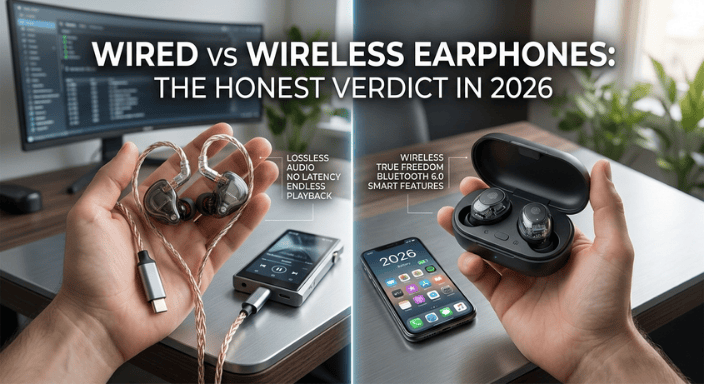
Description: Wired vs wireless earphones — which is actually better in 2026? We break down sound quality, convenience, battery life, and value so you can decide smart.
The Cable Debate That Refuses to Die
Nobody expected wired earphones to put up this much of a fight.
When Apple pulled the headphone jack from the iPhone 7 back in 2016 and handed everyone a Lightning dongle with a straight face, the tech world largely agreed: the wire was done. Finished. A relic headed for the same drawer as your old USB-A cables and that charger that only works for one device you no longer own.
And yet, here we are in 2026, and wired earphones are not only still alive — they're experiencing a genuine cultural renaissance. Audiophile forums are packed with wired enthusiasts. Gen Z has made the wired look a style statement. Professional musicians and studio engineers never left. And a growing number of everyday listeners, burned by dead batteries and dropped Bluetooth connections, are quietly plugging back in and wondering why they ever stopped.
Meanwhile, wireless earphones have become the dominant consumer choice by a massive margin — more convenient, more capable, and more impressive with every product generation. The best wireless earbuds in 2026 do things that would have seemed impossible five years ago.
So which is actually better? The honest answer, predictably, is: it depends. But that answer is only useful if we unpack exactly what it depends on — and that's precisely what this guide does.
We're going to cover everything: sound quality, convenience, battery life, durability, price, health considerations, and the specific use cases where each option genuinely wins. No brand loyalty, no hype — just a clear-eyed comparison so you can make the right call for your actual life.
A Brief History of How We Got Here
Understanding the wired vs wireless debate in 2026 requires knowing how we arrived at this point — because the trajectory tells you a lot about where the technology actually stands.
Wired earphones dominated personal audio for decades for a simple reason: the technology was mature, reliable, and the physics were in its favor. A physical cable carries audio as an electrical signal directly from the source to the driver. No compression, no conversion, no wireless protocol, no battery required. Simple, direct, effective.
The first Bluetooth earphones appeared in the early 2000s but were clunky, unreliable, and sounded noticeably worse than their wired counterparts. For years, "Bluetooth audio" was synonymous with convenience-over-quality — the trade-off was accepted but real.
Two things changed everything. First, Bluetooth codec development — particularly the emergence of aptX, AAC, LDAC, and eventually aptX Lossless — dramatically improved the quality of wireless audio transmission, narrowing and in some cases effectively closing the audible gap with wired connections for most listeners. Second, True Wireless Stereo (TWS) technology arrived, eliminating the wire between earbuds entirely and creating a form factor that the market immediately and enthusiastically adopted.
The AirPods launch in 2016 wasn't just a product launch — it was a cultural inflection point. Suddenly wireless earbuds were a status item, a design statement, and the template for an entirely new product category. Sales figures that followed were staggering and never really reversed.
But here's what that commercial dominance obscured: wired earphones didn't get worse when wireless got better. They stayed exactly as good — and at many price points, continued to offer superior value. The market shifted; the physics didn't.
Sound Quality: The Honest Comparison
This is the section audiophiles care about most, and it deserves a nuanced answer rather than a simple winner declaration.
The Wired Advantage
Wired earphones have a fundamental technical advantage: the audio signal travels as an analog electrical signal directly from your device's DAC (digital-to-analog converter) through the cable to the driver. There's no wireless transmission, no compression algorithm, no Bluetooth stack to introduce latency or artifacts.
This matters most at the extremes of the audio quality spectrum. A high-quality wired IEM (in-ear monitor) connected to a dedicated DAC/amp can resolve fine audio details — micro-dynamics, spatial cues, subtle instrument separation — that a wireless connection may compress or soften.
For serious listening — critical music appreciation, studio monitoring, audiophile-grade gear — wired remains the reference standard. The best wired IEMs in the $200–$500 range consistently outperform wireless earbuds at the same price point in controlled listening tests, because the wireless budget goes partly toward Bluetooth hardware rather than entirely toward driver and acoustic engineering.
The Wireless Catch-Up
Here's where it gets interesting. For the vast majority of listeners in everyday listening conditions, modern wireless earphones have effectively closed the audible quality gap.
The LDAC codec (used primarily on Android and Sony devices) transmits audio at up to 990 kbps — three times the bitrate of standard Bluetooth — and delivers audio quality that genuinely approaches lossless in double-blind tests. aptX Lossless, available on select devices and earphones, technically achieves CD-quality 16-bit/44.1kHz audio over Bluetooth.
The practical reality is this: if you're listening to Spotify Premium, Apple Music, or YouTube Music on a commute, in the gym, or at your desk — the difference between a good wireless earphone and a good wired earphone at the same price is not something most people will reliably identify in a blind test. The gap exists in measurements and at the extreme end of the quality spectrum. For typical daily listening, it's largely academic.
Where wireless audio still falls measurably short:
- Lossless audio at the highest resolution — FLAC files above 24-bit/96kHz push beyond what current Bluetooth codecs can transmit without compression
- Gaming and video — Bluetooth latency, even with low-latency modes, remains higher than wired for applications where audio sync is critical
- Professional monitoring — Studio engineers and serious musicians working with reference-grade audio rely on wired for accuracy
The Verdict on Sound
Wired wins on technical merit at equivalent price points. Wireless has narrowed the gap dramatically and satisfies the vast majority of listeners in real-world use. If audio quality is your single most important criterion and you're spending $150+, wired gives you more driver quality per dollar. For everyone else, a good wireless option at the same price sounds excellent.
Convenience: No Contest
Let's be straightforward about this one.
Wireless earphones win on convenience by a margin that isn't close. This is their entire value proposition, and they deliver it decisively.
No cable means:
- No tangling — ever
- No cable catching on door handles, bag straps, or your own hands
- No wire noise (the irritating rustling sound cables make against clothing, picked up by the microphone)
- Complete freedom of movement during exercise, commuting, and physical activity
- Seamless device switching on premium models
- Touch controls and voice assistant access without touching your device
The case-and-charging system on true wireless earbuds has also become genuinely excellent. Open the case near a paired device and the earbuds connect in seconds. The muscle memory of grabbing your earbuds and having them ready in under ten seconds is something wired users don't always appreciate until they've lived with it.
For workouts specifically, the wireless advantage is profound. Running with a cable connecting your ears to a device in your pocket introduces a category of minor, constant irritation that wired users simply accept because they've never experienced the alternative. Wireless users find it incomprehensible.
Wired earphones score convenience points in one specific area: you never have to charge them. They work every single time you plug them in, at any battery level, with any compatible device. That reliability has genuine value — particularly in high-stakes situations like long flights, international travel, or using a work device where you can't install apps.
Battery Life and the Dead Earbud Problem
This is where wireless earphones extract their tax on convenience.
Battery anxiety is a real phenomenon among wireless earbud users. The specific dread of reaching for your earbuds, finding them uncharged, and either scrambling for a cable or sitting in silence on a commute is a first-world problem that is nonetheless genuinely annoying.
Current wireless earbud battery life in 2026:
| Category | Earbud Battery | With Case (Total) |
|---|---|---|
| Budget TWS | 4–6 hours | 16–24 hours |
| Mid-range TWS | 6–8 hours | 24–36 hours |
| Premium TWS | 8–10 hours | 30–40 hours |
| ANC enabled (premium) | 5–7 hours | 20–28 hours |
For most daily use patterns — a commute, a workout, a workday — the battery life on a modern wireless earbud is sufficient. The case charge covers multiple days of normal use between full recharges.
But "sufficient" isn't "infinite," and the moments when battery management matters do arrive. Long-haul flights. Full workdays with ANC active. Travel days where you forgot to charge the case. These situations expose the fundamental limitation.
Wired earphones have zero battery anxiety. Zero. Plug in and use for as long as you want. On a 14-hour flight, with a dead phone battery, through a power outage — wired earphones work. That reliability is worth something, even if it's not the primary consideration for most people.
Durability and Longevity
This is an underappreciated dimension of the wired vs wireless comparison that tends to only become apparent years into ownership.
Wired Durability
Wired earphones have two common failure points: the cable and the 3.5mm jack. Both are subject to physical stress over time — particularly at the junction between the cable and the connector or earbud body, where bending and tension are concentrated. Cheap wired earphones fail here predictably within a year.
However — and this is important — quality wired earphones with braided or reinforced cables can last many years with reasonable care. The Shure SE215, for example, has been in production since 2010 and units from that era still function today. There are no electronics to degrade beyond the driver itself, which is robust and long-lived.
And critically: if the cable fails, you replace the cable. Many quality wired IEMs use detachable cables precisely for this reason. A $15 replacement cable restores a $200 IEM to full function. That's a remarkably sustainable repair model.
Wireless Durability
Wireless earphones introduce components that wired earphones simply don't have — and those components have finite lifespans.
The battery is the primary concern. Lithium-ion batteries degrade with charge cycles, and most wireless earbuds are rated for 300–500 full charge cycles before capacity drops noticeably. At one full charge per day, that's roughly 1–2 years before you start noticing meaningfully reduced battery life.
Unlike a phone or laptop where battery replacement is at least theoretically possible, most true wireless earbuds are assembled with batteries glued in place in tiny enclosures. Manufacturer battery replacement programs exist for some premium models but are often not cost-effective — replacement costs can approach the price of a new unit.
Water and sweat resistance has improved dramatically, with IPX4 and IPX5 ratings now common even on budget wireless earbuds. But wireless earphones have more components, more openings, and more complex sealing requirements than wired ones. Long-term moisture exposure remains a bigger risk.
The honest durability verdict: a quality wired earphone, treated reasonably, can last 5–10 years. A wireless earbud's practical lifespan is typically 2–4 years before battery degradation makes it less functional — at which point most users replace rather than repair.
For the environmentally conscious: this is a real concern. The waste generated by the TWS earbud upgrade cycle is significant and largely unavoidable given current battery replacement limitations.
Price and Value: Where Wired Absolutely Wins
This is perhaps the most compelling argument for wired earphones that rarely gets enough attention in mainstream tech coverage.
At every price point up to approximately $150, wired earphones offer measurably better acoustic performance per dollar than wireless alternatives. The reason is simple: wireless earphones have to spend a portion of their bill of materials on Bluetooth chips, batteries, charging hardware, microphones for the wireless stack, and packaging for the case. Wired earphones spend almost all of their cost on driver quality and acoustic engineering.
Consider what different budgets actually buy:
| Budget | Wired Option | Wireless Option |
|---|---|---|
| $20–$40 | Decent driver quality, reasonable sound | Basic TWS, mediocre sound, short battery |
| $50–$100 | Excellent sound, good IEM-level detail | Competent TWS, improving sound |
| $100–$200 | Audiophile-grade IEMs, exceptional detail | Good TWS with ANC, solid overall package |
| $200–$400 | Reference-grade sound, professional use | Premium TWS, excellent all-around |
| $400+ | Summit-fi performance | Flagship TWS, marginal improvements |
The $50–$150 range is where the wired value advantage is most striking. The Moondrop Aria, KZ ZS10 Pro, and 7Hz Salnotes Zero — all under $50 wired IEMs — regularly outperform wireless earbuds at three times their price in blind listening tests. For budget-conscious listeners who care about audio quality, this is not a trivial difference.
Health and Hearing Considerations
A dimension of the debate that deserves more attention than it gets.
Wireless and RF Exposure
Wireless earbuds use Bluetooth, which emits low-level radiofrequency (RF) radiation. The scientific consensus as of 2026 is that Bluetooth RF exposure at the levels produced by consumer earphones is well within safety guidelines and not associated with health harm. The power levels involved are extremely low — significantly lower than a mobile phone held against your ear.
That said, some people prefer to minimize any RF exposure as a precautionary measure, particularly for extended daily use. For these users, wired earphones offer complete elimination of RF concerns.
Hearing Health
Both wired and wireless earphones present the same fundamental hearing risk: volume. Prolonged exposure to audio above 85 decibels causes cumulative hearing damage — and in-ear earphones, by their nature, deliver sound directly to the ear canal at high efficiency.
Modern wireless earphones increasingly include built-in volume limiting and hearing health features (Apple, Samsung, and Sony all offer these). Wired earphones typically don't include these protections natively — the source device may offer volume limiting, but it's less consistently applied.
The more meaningful hearing health consideration for both types: use them at sensible volumes. The 60/60 rule — no more than 60% volume for no more than 60 minutes at a stretch — remains solid practical guidance regardless of whether your earphones have a cable.
Use Case Breakdown: Who Should Choose What
Choose Wired If:
You're an audiophile or serious music listener who wants the best possible sound quality for your budget. Wired IEMs in the $50–$200 range offer genuinely exceptional audio that wireless earphones at the same price can't match.
You play games or watch video where audio latency matters. The zero-latency of a wired connection eliminates the sync issues that even low-latency Bluetooth modes can produce.
You work in a studio or professional audio environment. Reference monitoring requires wired connections for accuracy. No professional mastering engineer is working with Bluetooth.
You're on a tight budget and prioritize sound quality over convenience. The wired value proposition at under $50 is unbeatable.
You use a device with a 3.5mm jack and don't need wireless functionality. If the port is there, use it.
You're environmentally conscious about electronic waste and want a product that can last years without battery degradation forcing replacement.
Choose Wireless If:
You exercise regularly. Cable-free workout audio is a genuinely superior experience. Sweat-resistant wireless earbuds have removed the last major practical objection.
You commute or travel frequently and want ANC, effortless device switching, and complete freedom of movement.
You take calls or attend meetings regularly from variable environments. Premium wireless earbuds combine ANC for your listening with ENC for your voice transmission in a package wired earphones simply can't match.
Convenience is your top priority. If audio quality matters but isn't your singular obsession, a good wireless earbud at $100–$150 sounds excellent and adds enormous practical value.
Your devices don't have a 3.5mm jack. Modern iPhones, many Android flagships, and tablets have removed the headphone port. Wireless removes the dongle frustration entirely.
The 2026 Reality Check
Here's where we land in 2026, with clarity about what the market actually looks like.
Wireless earphones have won the mass market. Full stop. The convenience advantage, the improving sound quality, the fashion element, and the sheer breadth of available products have made them the default choice for most people — and that's a reasonable outcome given how good the best products are.
But wired earphones occupy a resilient and in some ways growing niche: audiophiles, budget-focused listeners, professionals, gamers, and a culturally self-aware younger generation that has reclaimed the cable as a statement against the disposable wireless upgrade cycle.
Neither is dying. Both are thriving in their respective lanes.
The Honest Bottom Line
Buy wired if sound quality per dollar is your primary concern, if you game or work with professional audio, if you want gear that lasts a decade, or if you simply prefer the reliability of never charging your earphones.
Buy wireless if you exercise, commute, take calls, or value the freedom of movement that a cable permanently eliminates — and you're willing to manage a charging routine to get it.
Buy both if you're a serious listener who wants daily-use wireless convenience and a wired reference option for critical listening. At current price points, this is genuinely achievable.
The wire isn't inferior. The wireless isn't lazy. They're different tools built for different priorities — and the best choice is simply the one that matches your actual life.
Team wired, team wireless, or running both? Drop your setup in the comments — and if this helped you finally make the call, share it with someone still stuck in the headphone aisle.
