ANC vs ENC Explained: Which Noise-Cancelling Tech Actually Wins?
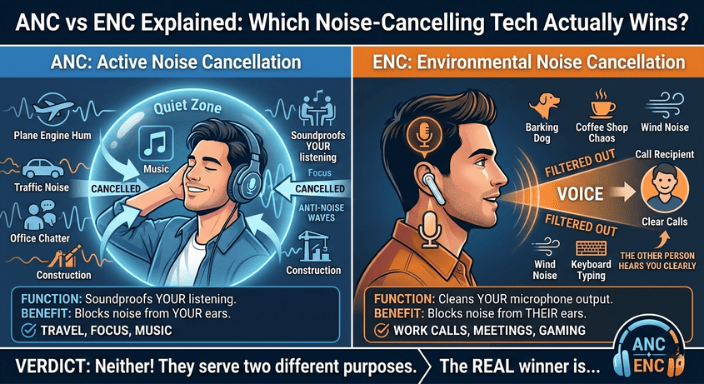
Description: ANC vs ENC — what's the difference and which one do you actually need? We break down both technologies in plain English so you can buy smarter.
Two Acronyms, One Very Common Confusion
You're shopping for earbuds or headphones. You've narrowed it down to two options that look almost identical, cost roughly the same, and have nearly identical spec sheets. Then you notice it — one says ANC, the other says ENC. Both claim to cancel noise. Both sound like they do the same thing.
They don't.
This is one of the most common points of confusion in the consumer audio world right now, and it's not helped by the fact that marketing departments are extremely motivated to make both technologies sound equally impressive. Slap "noise cancelling" on the box and it moves units — whether the technology is sophisticated active noise cancellation or a relatively simple microphone filter designed for phone calls.
The truth is that ANC and ENC are genuinely different technologies, built for different purposes, and the right choice depends entirely on what you're trying to do with your audio gear. Buying the wrong one isn't just a minor inconvenience — it's the specific frustration of spending money on a feature that doesn't actually solve your problem.
So let's clear this up completely. By the end of this guide, you'll know exactly what each technology does, how it works, where it excels, where it falls short, and which one you should be looking for based on your actual life.
What Is ANC? Active Noise Cancellation Explained
Active Noise Cancellation is the older, more sophisticated, and more widely recognized of the two technologies. When people say "noise-cancelling headphones," they almost always mean ANC — and it's the technology responsible for making a noisy plane, a loud commute, or a chaotic open office feel like it's been turned down several notches.
How ANC Actually Works
The physics behind ANC is genuinely elegant, even if the implementation is complex.
Sound, at its most basic, is a pressure wave moving through air. It has peaks — moments of high pressure — and troughs — moments of low pressure. These alternate in a regular cycle, and the frequency of that cycle determines the pitch of the sound.
ANC exploits a principle called destructive interference. If you take a sound wave and introduce an identical sound wave that is perfectly out of phase — where the original wave has a peak, the new wave has a trough, and vice versa — the two waves cancel each other out. The peaks fill the troughs, the troughs fill the peaks, and the result is silence.
Or significantly reduced noise, in practice.
Here's how ANC headphones execute this in real time:
- External microphones on the outside of the ear cup or earbud continuously sample the ambient sound around you — the engine hum of a plane, the rumble of a train, the low-frequency drone of an air conditioning unit.
- This audio signal is sent to an onboard processor (the ANC chip) which analyzes the incoming sound wave in real time — essentially reading its shape, frequency, and phase.
- The processor generates an anti-noise signal — a sound wave that is mathematically the mirror image of the incoming noise, perfectly inverted.
- This anti-noise signal is fed into the headphone drivers along with your audio, so both signals reach your ears simultaneously.
- The original noise wave and the anti-noise wave cancel each other out at your eardrum — and you hear dramatically less of the ambient sound around you.
This entire process happens in milliseconds, continuously, and adapts in real time as the ambient noise changes. It's a remarkable piece of engineering that fits inside a pair of earbuds small enough to lose in a jacket pocket.
What ANC Is Good At
ANC excels at consistent, low-frequency sounds. Think:
- Aircraft engine rumble
- Train and subway noise
- Air conditioning and HVAC hum
- Road noise in cars and buses
- Fan noise from computers and appliances
These are the sounds ANC was designed for, and top-tier ANC headphones — the Sony WH-1000XM5, Bose QuietComfort Ultra, Apple AirPods Pro — are extraordinarily effective at making them disappear. Put on a good pair of ANC headphones on a long-haul flight and the experience is genuinely transformative. The fatigue that comes from hours of low-frequency noise exposure is real, and ANC eliminates it.
What ANC Struggles With
ANC has meaningful limitations that its marketing rarely highlights.
High-frequency sounds are harder to cancel. Human voices, sudden sharp sounds, higher-pitched noises — the anti-noise processing has to work faster as frequency increases, and there's a practical limit to how quickly the system can respond. ANC softens these sounds rather than eliminating them.
Variable and unpredictable sounds are challenging. ANC works best on consistent noise with a regular waveform. Sudden, unpredictable sounds — a door slamming, a dog barking, a keyboard clacking — are harder to predict and cancel in real time.
Passive seal matters enormously. ANC doesn't work in isolation. The physical fit of the ear cup or earbud creates a passive seal that blocks sound before ANC even activates. Poor fit means poor passive isolation, which means the ANC has more to do and does it less effectively. This is why fit is so critical with ANC products.
Some people experience ANC pressure sensation. A notable minority of users find that active ANC creates a slight pressure or suction sensation in the ears — not painful, but uncomfortable enough to be distracting. It's a known phenomenon and worth knowing about before you commit to an ANC product.
Hybrid ANC: The Next Level
Premium ANC products now typically use Hybrid ANC — a system with both external microphones (sampling noise outside the ear cup) and internal microphones (sampling any residual noise that makes it through the passive seal). The processor uses both data streams to generate more precise anti-noise signals.
The result is significantly more effective cancellation across a wider range of frequencies. The Sony XM5 and Bose QC Ultra both use hybrid systems, and the performance difference versus single-microphone ANC is substantial.
What Is ENC? Environmental Noise Cancellation Explained
Environmental Noise Cancellation is a fundamentally different technology with a fundamentally different purpose. Where ANC is designed to improve what you hear, ENC is designed to improve what others hear from you.
This distinction is everything.
How ENC Works
ENC is a microphone processing technology. It's not concerned with your listening experience at all — it's entirely focused on making your voice sound cleaner and clearer to whoever is on the other end of a call, a voice message, or a video meeting.
The core mechanism uses multiple microphones working together:
- Primary microphone captures your voice from close range — typically positioned near your mouth.
- Secondary reference microphone(s) are positioned differently — often facing outward or at an angle — to capture the ambient environmental noise around you.
- Signal processing algorithms compare the inputs from both microphones. The logic is: your voice appears strongly in the primary mic and weakly in the reference mic. Environmental noise appears in both mics at similar levels.
- By subtracting the reference mic signal from the primary mic signal, the algorithm can eliminate sounds that are common to both microphones — i.e., the background noise — while preserving the sounds unique to the primary mic — i.e., your voice.
- The result is a transmitted audio signal that contains mostly your voice with significantly reduced background noise.
Modern ENC implementations add AI and machine learning to this process. Rather than relying purely on the mathematical difference between microphone inputs, AI-trained models can distinguish between human voice patterns and environmental noise with increasing accuracy — filtering out a running washing machine while preserving the nuance of your speech.
What ENC Is Good At
ENC shines in communication clarity situations:
- Phone and video calls in noisy environments
- Voice messages recorded outdoors or in busy spaces
- Remote work video conferencing from imperfect environments
- Gaming chat with background noise (keyboard clicks, room noise)
- Voice assistants recognizing commands in noisy spaces
If you've ever been on a call with someone who has good ENC and found yourself surprised by how clear they sounded despite being on a busy street — that's ENC doing its job. The person at the coffee shop, on the train platform, or next to a running lawnmower who still sounds like they're in a quiet room? ENC.
It's a profoundly practical technology for modern life, where taking calls from perfectly quiet environments is increasingly a luxury rather than a standard condition.
What ENC Cannot Do
The critical limitation of ENC is that it does nothing for your own listening experience.
When you're on a call with ENC active, the person on the other end hears your voice more clearly. But your ears are still fully exposed to whatever environment you're in. The coffee shop chatter, the traffic noise, the construction outside — all of it reaches you completely unfiltered.
This is where the confusion between ANC and ENC does genuine consumer harm. Someone buys ENC earbuds expecting to feel the noise disappear around them — the way they've seen ANC demonstrated — and nothing happens. The noise is still there. They feel cheated. The product isn't broken; it was simply the wrong product for their expectation.
ENC also has no effect on the audio you're listening to. Music, podcasts, videos — ENC doesn't touch any of it. It only processes the microphone signal going out, not the audio signal coming in.
ANC vs ENC: Side-by-Side Comparison
Let's put this directly on the table.
| Feature | ANC | ENC |
|---|---|---|
| Primary purpose | Improve what you hear | Improve what others hear from you |
| Technology type | Speaker + microphone + processor | Microphone + DSP/AI processing |
| Affects listening? | Yes — reduces ambient noise | No effect on listening |
| Affects calls? | Minimal — some passive benefit | Yes — dramatically cleaner voice |
| Best for | Commuting, flights, focus work | Calls, meetings, voice messages |
| Works on music? | Yes — quieter environment for music | No — microphone-only tech |
| Power consumption | Higher (active signal processing) | Lower (mic processing only) |
| Price impact | Significantly increases cost | Modest cost increase |
| Physical feel | Some users feel pressure sensation | No physical sensation |
| Typical products | Premium headphones and earbuds | Mid-range earbuds, business earbuds |
Can You Have Both? Yes — And This Is Where It Gets Interesting
The good news for anyone who wants the best of both worlds: many modern earbuds now include both ANC and ENC simultaneously, and the combination is genuinely excellent.
A pair of earbuds with both technologies gives you:
- ANC active — reducing the environmental noise you personally hear while listening to music or taking a call
- ENC active — ensuring your voice transmits cleanly to the person on the other end, despite whatever residual noise is around you
On a practical level, this means you can take a call on a noisy train, hear the other person clearly (ANC reducing ambient noise in your ears), and have them hear you clearly (ENC cleaning your transmitted voice). That's a genuinely good experience — the kind that makes working remotely or commuting while staying connected feel much less friction-filled.
Products that credibly deliver both include the Apple AirPods Pro 2nd generation, Sony WF-1000XM5, Samsung Galaxy Buds 2 Pro, and increasingly, a range of mid-range options from brands like Anker (Soundcore), Jabra, and Edifier.
When shopping, look for both terms listed explicitly in the specifications — not just one with the other implied. Marketing copy sometimes uses "noise cancellation" to describe both technologies indiscriminately, which is unhelpful. Drill into the spec sheet.
Which One Do You Actually Need?
This is the most important question, and the answer depends entirely on your use case. Let's map it out honestly.
You Need ANC If:
You commute regularly by train, bus, or plane. This is ANC's absolute sweet spot. The low-frequency rumble of transit noise is exactly what ANC was designed to eliminate. A good pair of ANC headphones transforms a daily commute from an endurance test into something almost pleasant.
You work in a noisy open office or shared space. ANC combined with music or ambient sound can create a bubble of focus in an otherwise chaotic environment. Many remote and hybrid workers consider ANC headphones a professional productivity tool rather than an audio luxury.
You travel frequently. Long-haul flights with ANC headphones feel dramatically shorter because the noise fatigue is eliminated. The constant 80-90 decibel drone of aircraft engines is exhausting in a way you don't fully notice until it's gone.
You want to fully immerse in music, podcasts, or audio content. ANC creates a quieter listening environment that lets you appreciate audio at lower volumes — which is also better for your hearing long-term.
You Need ENC If:
You take a lot of calls from variable environments. Working from home with noisy kids, pets, or street noise? Taking calls from coffee shops or outdoors? ENC ensures your professional credibility doesn't depend on having a perfectly quiet room.
You're in remote meetings frequently. Video conferencing has become a professional standard, and audio quality is often what separates a frustrating call from a productive one. Good ENC on your end reduces the cognitive load for everyone in the meeting.
You use voice messages or voice-to-text regularly. ENC significantly improves transcription accuracy and voice message clarity in noisy conditions.
You game online with voice chat. Keyboard noise, room ambience, and background sounds are classic gaming headset problems. ENC-equipped gaming earbuds keep your callouts clean without requiring a dedicated boom microphone.
You Need Both If:
You do all of the above. Modern life for most professionals — particularly those who commute, work remotely, and take calls throughout the day — genuinely benefits from both technologies running simultaneously. The premium for getting both has dropped considerably as the tech has matured.
The Quality Spectrum: Not All ANC and ENC Is Equal
Here's a nuance that marketing consistently obscures: having ANC or ENC labeled on a product tells you the technology is present. It tells you nothing about how well it's implemented.
Low-quality ANC can actually make audio worse — introducing hiss, white noise artifacts, or creating that uncomfortable pressure sensation without delivering meaningful noise reduction. Some budget ANC products cancel a narrow range of frequencies poorly and generate audible noise in the process. You'd genuinely be better off without it.
High-quality ANC — the kind in Sony's XM series, Bose's QC line, or Apple's AirPods Pro — is transformatively good. The difference between cheap ANC and premium ANC is far larger than the difference between no ANC and cheap ANC.
Similarly, basic ENC using simple multi-microphone subtraction is considerably less effective than AI-powered ENC that uses trained models to identify and separate voice from noise. The former works reasonably well in moderate noise; the latter performs impressively in genuinely challenging environments.
When evaluating products, look beyond the presence of a feature and toward the implementation quality. Independent reviews from audio-focused publications — The Verge, Rtings, What Hi-Fi — provide objective testing of both ANC effectiveness and call quality that manufacturer spec sheets never will.
Common Myths Worth Busting
"ENC headphones will help me block out noise while working." No. ENC processes your microphone signal only. It has zero effect on what you hear. For focus and noise blocking, you need ANC or simply good passive isolation.
"ANC makes phone calls clearer for me." Partially. ANC reduces ambient noise in your ears, so you may hear the person on the other end more clearly in noisy environments. But it doesn't clean up your transmitted voice. For that, you need ENC.
"Higher ANC dB rating always means better performance." Not necessarily. Published dB reduction figures are measured at specific frequencies under controlled conditions. Real-world performance depends on fit, frequency range, and implementation quality. A product claiming 35dB reduction can perform worse in practice than one claiming 30dB, if the former achieves its number only at narrow frequencies.
"ANC and ENC are the same thing with different names." A genuine misconception that costs people money. They are different technologies solving different problems. One affects your ears; the other affects your microphone.
Quick Buying Guide Summary
Before you add anything to your cart, answer these three questions:
1. What's my primary frustration?
- Noisy environment bothering me while listening → ANC
- People on calls complaining about noise from my end → ENC
- Both → Look for products with both
2. What's my primary use context?
- Commuting / travel / focus work → ANC priority
- Calls / meetings / voice communication → ENC priority
- All-day mixed use → Both
3. What's my budget reality?
- Under $50: Don't expect meaningful ANC; reasonable ENC is achievable
- $50–$120: Decent ANC on a few models; good ENC widely available
- $120–$200: Good ANC plus good ENC starts to become reliably available
- $200+: Excellent ANC with premium ENC — this is where it gets genuinely impressive
The Bottom Line
ANC and ENC are not competitors. They're not even in the same category, really — one is an audio technology, the other is a communications technology. The confusion between them is a marketing problem, not a technical one.
ANC is for your ears. It makes your world quieter so you can listen better, focus harder, and travel with less fatigue. It's one of the most genuinely life-improving audio technologies developed in the last two decades.
ENC is for your voice. It makes your communications cleaner so the people you're talking to can hear you properly regardless of where you are. In a world where remote work, mobile calling, and video meetings are the norm, that's not a small thing.
Know what problem you're actually trying to solve, find a product that solves it well, and stop letting overlapping acronyms complicate what is, at its core, a straightforward decision.
Buy the right technology. Enjoy the silence — or the clarity, depending on which one you chose.
Which do you use more — ANC for your own focus or ENC for cleaner calls? Drop your setup in the comments. And if this finally cleared up the confusion, share it with someone who's been staring at headphone specs trying to figure out the same thing.
