Xiaomi's Dark Factory: The Future of Manufacturing Without Humans
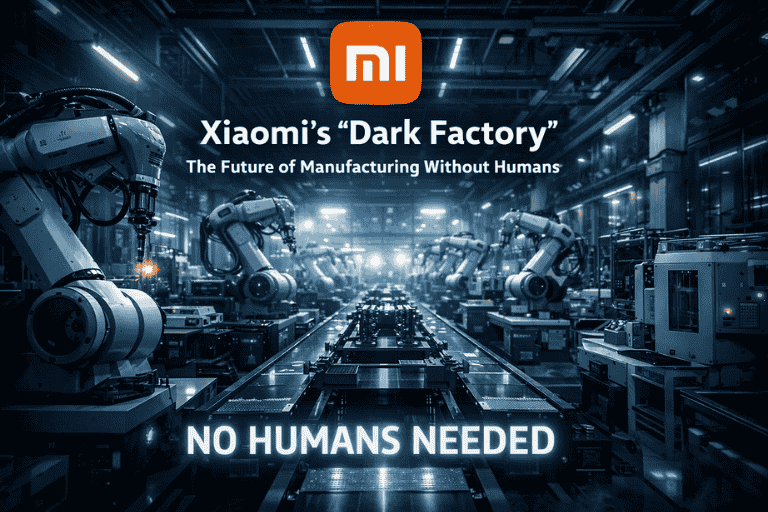
Xiaomi's Belgium AI Factory: The Future of Manufacturing Without Humans
In the heart of Europe, a quiet revolution is unfolding that could reshape how we think about manufacturing, employment, and the future of industry. Xiaomi, the Chinese technology giant known for smartphones and consumer electronics, has established what it calls a "lights-out" factory in Belgium—a fully automated manufacturing facility where artificial intelligence and robotics handle every aspect of production, and human workers are almost entirely absent from the factory floor.
This isn't science fiction or a distant future prediction. It's happening right now, and it represents both the promise and the peril of our increasingly automated world.
Xiaomi's "Dark Factory": The Future of Manufacturing Without Humans
In Beijing's Changping district, something extraordinary is happening that represents both the promise and the peril of our automated future. Xiaomi, the Chinese technology giant, has built what many consider the world's most advanced manufacturing facility—a fully automated "dark factory" where artificial intelligence and robotics handle every aspect of smartphone production, and human workers are almost entirely absent from the factory floor.
This isn't a prototype or an experiment. It's an 81,000 square meter facility—about the size of 11 soccer fields—that operates 24/7 without a single human on the floor, producing smartphones at a rate of one per second, with an annual production capacity of 10 million high-end devices YourStoryInteresting Engineering.
What Makes This Factory "Dark"?
The term "dark factory" stems from both the lack of humans and light—without people, there's no need to keep the lights on, as robots don't need them to perform their tasks BGR. This isn't just clever branding; it's a literal description of a facility operating in darkness because machines, unlike humans, don't need illumination to work.
The facility runs entirely without on-site staff, with autonomous systems handling every step of production, from materials handling to component assembly—representing a sophisticated blend of artificial intelligence, robotics, and real-time data analytics that allows the factory to monitor and correct its own operations Convergence-now.
The Brain Behind the Operation
At the heart of this revolutionary facility lies something Xiaomi calls the Hyper Intelligent Manufacturing Platform, or HyperIMP. Unlike traditional automation where machines execute predefined tasks, HyperIMP continuously analyzes operational data, predicts potential issues, and initiates corrective actions without any human intervention YourStory.
According to Xiaomi CEO Lei Jun, the platform can identify and solve issues while also helping to improve the production process, with the system having self-perception, self-decision-making, and self-execution capabilities that allow it to independently diagnose equipment problems and improve process flows New Atlas.
Think about what this means: The factory doesn't just follow instructions—it learns, adapts, and improves itself over time. The AI resolves minor defects, sensor issues, and operational tweaks without any human intervention—Xiaomi didn't just teach robots to build, it taught them to think like engineers YourStory.
How It Actually Works
The scale and sophistication of operations inside this facility are staggering. There are 11 production lines where 100% of the key processes are automated, with Xiaomi having developed its entire production and manufacturing software to achieve this level of autonomy Interesting Engineering.
The manufacturing process is coordinated by thousands of sensors and an AI-driven system handling assembly, inspection, material handling, and environmental control without human intervention, using advanced computer vision systems that inspect each component with microscopic precision BGRCio Visionaries.
The attention to cleanliness is remarkable. The facility maintains micron-level dust removal, creating a super-clean environment Tech Steel & Materials—something that's easier to achieve when you don't have humans shedding skin cells, hair, and bringing in contaminants from outside.
Automated guided vehicles (AGVs) and AI-driven warehouse management systems optimize material handling and distribution, with the factory collecting and analyzing massive amounts of data in real time to continuously improve efficiency, detect defects, and adjust production processes Cio Visionaries.
The Production Marvel
The output numbers are almost hard to believe. Company reports indicate that this dark factory can produce up to 10 million smartphones annually—at full capacity, that's an average of one smartphone per second BGR.
The factory can produce a smartphone every 1-3 seconds, which is particularly impressive considering the facility manufactures foldable smartphones like the MIX Fold 4 and MIX Flip—devices with fragile flexible displays that require extraordinary precision Tech Steel & Materials.
What makes this even more remarkable is the scope of automation. The facility features 96.8% self-developed packaging equipment and 100% self-developed software, holding over 500 patents Interesting Engineering. This isn't Xiaomi buying off-the-shelf automation solutions—they built the entire system themselves.
The War Room: Where Humans Still Matter
While the factory floor operates without human presence, people haven't been eliminated entirely. A few individuals monitor the Xiaomi Hyper Intelligent Manufacturing Platform from what CEO Lei Jun refers to as the "War Room" NewsBytes.
These aren't traditional factory workers but highly skilled technicians and engineers who oversee the AI systems, make strategic decisions, and intervene only when the AI encounters problems beyond its capabilities. The role has transformed from hands-on manufacturing to high-level system oversight.
Beyond Smartphones: The Wuhan Facility
Xiaomi hasn't stopped with its Beijing smartphone factory. The company's fully automated finished goods warehouse in Wuhan is now processing 90,000 sets per day, handling 260+ pallets per hour in a 24-meter-high automated storage tower built inside the factory Gizchina.
This facility manufactures products like air conditioners at a rate of one every 6.5 seconds, with factory-warehouse integration eliminating the "logistics gap"—products are instantly moved into the automated system rather than sitting on loading docks Gizchina.
China's Automation Revolution
Xiaomi's dark factory isn't an isolated example—it's part of a massive nationwide transformation. According to the International Federation of Robotics, China deployed over 290,000 industrial robots in 2023 alone, accounting for nearly 52% of global robot installations YourStory.
China's industrial landscape is being reshaped as robots take over human labor, with hundreds of thousands of industrial robots deployed annually for automation, giving China a global lead in factory robotics BGRAOL.
This represents a strategic shift. For years, many stereotyped China's manufacturing dominance as "cheap labor," but China has pivoted to cheap automation, which is a whole different beast YourStory.
The Environmental Angle
One often-overlooked benefit of dark factories is their environmental efficiency. The dark factory is designed with sustainability in mind, with AI optimizing energy consumption, reducing waste and lowering carbon emissions, while smart grid systems and renewable energy sources further enhance the factory's environmental footprint Cio Visionaries.
Operating in darkness saves electricity. AI-optimized processes reduce waste. Precision manufacturing minimizes defects and the resources wasted on rejected products. The 24/7 operation maximizes equipment utilization, reducing the per-unit environmental cost.
The Promise: Unprecedented Efficiency
The advantages of Xiaomi's approach are undeniable. The factory operates continuously without breaks, shifts, sick days, or vacation time. Quality control achieves consistency impossible for human workers. Production can scale rapidly without hiring and training challenges. Labor costs plummet.
The logic is simple: If machines are building, humans can be innovating YourStory. In theory, automation frees humans from repetitive, dangerous, or tedious work to focus on creative, strategic, and interpersonal tasks that machines can't replicate.
The factory can "realize full-scenario digital management from raw material procurement to delivery," creating unprecedented visibility and control over the entire production process New Atlas.
The Peril: Jobs and Inequality
But this technological marvel casts a long shadow. While dark factories improve efficiency, precision, and cut costs, this shift to fully automated manufacturing raises questions about the future of work and economic balance, with millions of traditional manufacturing jobs potentially lost if the workforce is replaced by machines BGRAOL.
The numbers are sobering. According to a World Economic Forum report from 2024, up to 85 million jobs globally could be displaced by automation by 2025, although 97 million new roles could also emerge in AI, data analysis, and tech fields YourStory.
That's cold comfort for workers whose skills don't transfer to these new roles. Workers who once relied on factory jobs face displacement, while the demand for highly specialized roles such as robotics maintenance and AI system programming is increasing—without robust retraining and reskilling programs, this will further increase economic disparity within regions and between skilled and unskilled labor pools BGRAOL.
The historical precedent isn't encouraging. In 2016, Foxconn trimmed its workforce by 60,000 by swapping them out for machines that work round-the-clock—Xiaomi's smart factory takes this automation to another level NewsBytes.
The Regional Impact
Areas historically dependent on labor-intensive manufacturing may see shrinking job markets, the urban-rural divide could intensify, and education inequality might deepen BGR. Regions that built their economies around factory employment face existential challenges when those factories eliminate most human workers.
This creates potential for social instability. When millions of people lose their economic purpose without clear alternatives, the resulting displacement, resentment, and economic hardship can have profound political and social consequences.
Other Concerns: Security and Control
Fully autonomous factories are juicy targets for cyberattacks, and over-reliance on AI decision-making raises critical ethical and control issues YourStory. If a hacker gains access to the HyperIMP system, they could theoretically shut down production, sabotage quality control, or steal proprietary manufacturing data.
The dependency on AI also creates vulnerability. What happens when the system encounters a problem outside its training data? How do you maintain institutional knowledge when the "knowledge" resides in algorithms rather than experienced workers? Who's responsible when AI makes a costly mistake?
Is This the Future for Everyone?
This shift isn't limited to phones—it's spreading to cars, appliances, chips, even construction materials YourStory. Dark factories represent a general trend rather than a niche application.
However, several factors will determine how widely this model spreads. The enormous capital investment required ($330 million for Xiaomi's Beijing facility) puts it out of reach for smaller manufacturers. Industries requiring more customization or shorter production runs may not benefit from such rigid automation. Products involving creativity, judgment, or complex human skills remain difficult to fully automate.
The future of manufacturing will likely be a hybrid model, where autonomous systems handle high-volume, repetitive tasks while humans focus on supervisory and maintenance work BGR.
What Should We Do About It?
AI is already taking some jobs, so the need for reskilling programs is greater than ever—Xiaomi's dark factory is both a promise and a warning, representing the power of innovation while exposing the human costs that can accompany total automation AOL.
Policymakers, educators, and businesses need to address several urgent questions:
Education and Training: How do we prepare workers for an economy where traditional manufacturing jobs are vanishing? What skills will be valuable in an AI-dominated industrial landscape?
Social Safety Nets: If technological unemployment accelerates, do we need new approaches like universal basic income, expanded retraining programs, or work-sharing arrangements?
Corporate Responsibility: Should companies that profit enormously from automation bear some responsibility for workers they displace? Should there be automation taxes to fund retraining or support displaced workers?
Pace of Transition: Should there be policies to slow automation's pace, giving workers and communities time to adapt? Or would such policies simply delay the inevitable while making businesses less competitive?
The Bigger Picture
Xiaomi's dark factory isn't just about smartphones. It's a glimpse into a future where human labor becomes optional in many industries. That future offers tremendous benefits—higher productivity, lower costs, better quality, reduced environmental impact.
But it also threatens to exacerbate inequality, creating a world where those who own or control automation technology prosper enormously while those who sell manual labor find their economic value approaching zero.
The technology itself is neither good nor bad. The question is how we choose to deploy it and how we distribute its benefits. Will we use automation to create abundance for all, or to concentrate wealth and power in fewer hands? Will we find meaningful roles for humans in an automated economy, or create a permanent underclass of people whose labor the economy no longer needs?
Conclusion: Lights Out, Questions Remain
Standing virtually in Xiaomi's dark factory—imagining robots working in silent darkness, assembling smartphones with superhuman precision, learning and adapting without human guidance—evokes both wonder and unease.
The technological achievement is remarkable. The efficiency is unprecedented. The implications are profound.
We're witnessing a fundamental transformation in how things are made and who makes them. Xiaomi's facility produces millions of smartphones without the armies of workers that such production once required. This is just the beginning—dark factories will spread to more industries, more countries, more products.
The lights are going out in factories worldwide, not because of power failures but because humans are leaving the floor. The machines work in darkness now, and they work brilliantly.
The question isn't whether this transformation will continue—it will. The question is whether we can ensure that when the lights go out in the factories, they don't also go out for the workers who once staffed them. Can we create an economy where automation's benefits are shared broadly, where displaced workers find new purpose and prosperity, where technological progress lifts everyone rather than leaving millions behind?
Xiaomi's dark factory demonstrates what's technologically possible. What remains to be seen is whether we possess the wisdom, compassion, and political will to ensure that this technological marvel becomes a blessing for humanity rather than a curse for those whose labor it renders obsolete.
The robots work in darkness. But the future they're building remains illuminated by the choices we make today.
