How AI is Changing Jobs in 2026 (Real Examples)
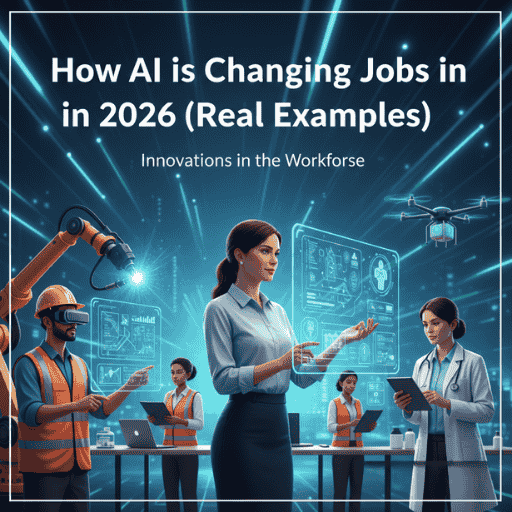
The workplace transformation we've witnessed over the past few years has accelerated dramatically. As we move through 2025, artificial intelligence isn't just a buzzword in corporate strategy decks—it's fundamentally reshaping how millions of people work, what skills matter, and even which jobs exist. But contrary to the apocalyptic predictions of mass unemployment, the reality is far more nuanced and, in many ways, more interesting.
The Customer Service Revolution
Perhaps nowhere is AI's impact more visible than in customer service. Companies like Klarna, the Swedish fintech giant, made headlines in early 2024 when they reported that their AI assistant was handling the equivalent work of 700 full-time agents. By 2025, this trend has matured significantly.
Sarah Chen, a customer service manager at a mid-sized e-commerce company in Seattle, describes the shift: "Three years ago, my team of 50 agents spent 80% of their time on routine queries—password resets, order tracking, return policies. Today, AI handles about 70% of incoming contacts completely autonomously. But here's what's interesting: I still have 45 people on my team."
What changed wasn't the headcount but the work itself. Sarah's team now focuses on complex problem-solving, angry customers who need empathy and creative solutions, and improving the AI system itself by identifying edge cases and training it on new scenarios. "We've become part customer advocate, part AI trainer, part business analyst," she explains. "The job is actually more interesting now, though it required significant retraining."
The pattern repeats across industries. AI handles the routine; humans handle the exceptions, the emotional, and the creative. But this transition hasn't been painless—many workers who couldn't or didn't want to adapt have left the industry entirely.
Healthcare's Dual Transformation
Dr. James Rodriguez, a radiologist at a Boston teaching hospital, was initially skeptical when AI-powered diagnostic tools began arriving in his department in 2022. "I thought, 'Here comes my replacement,'" he admits. "Three years later, I can't imagine working without it."
His daily routine now involves reviewing AI-flagged scans rather than examining every image from scratch. The AI catches subtle patterns—early-stage cancers, micro-fractures, rare conditions—that might take humans much longer to identify. "I'm seeing about 40% more patients than I did three years ago, but with better outcomes," Rodriguez says. "The AI does the initial screening with superhuman consistency. I provide the medical judgment, consider the patient's full history, and make the final call."
Meanwhile, in primary care, AI scribes have become ubiquitous. Dr. Lisa Park, a family physician in Austin, Texas, uses an AI assistant that listens to her patient conversations, generates notes, suggests relevant questions based on symptoms, and even flags potential drug interactions in real-time. "I actually make eye contact with my patients now," she says. "Before, I spent half the appointment staring at my computer screen, typing notes. Now I'm present, and the documentation is often better than what I used to write myself."
However, the transition has created new challenges. Nurses and medical assistants have had to learn to work alongside AI monitoring systems, and there's ongoing debate about liability when AI assists in diagnosis. Some medical professionals have struggled with the pace of change, particularly those later in their careers.
The Creative Industries: Collaboration, Not Replacement
The creative sector has perhaps faced the most anxiety about AI, yet it's also where some of the most interesting collaborations are emerging.
Marcus Thompson, a graphic designer at a advertising agency in London, initially felt threatened when AI image generators exploded in capability. "I went through a genuine crisis in 2023," he recalls. "I thought, 'Why would anyone pay me when they can generate images instantly?'"
His answer came through adaptation. Marcus now uses AI as a rapid prototyping tool, generating dozens of concept variations in minutes that would have taken days before. "I'll create 50 initial directions with AI, present the best 10 to clients, and then use my skills to refine, adjust, and perfect the chosen direction. The AI can't do the client relationship, can't understand their unstated preferences, can't make the subtle tweaks that turn a good design into a great one."
His agency hasn't laid off designers; instead, they've taken on more clients and expanded into motion graphics and 3D rendering—areas where AI tools have lowered the barrier to entry but human creativity remains essential.
In software development, the transformation is equally profound. GitHub Copilot and similar AI coding assistants are now standard tools, with newer versions handling increasingly complex tasks. Elena Kowalski, a senior developer at a fintech startup in Berlin, estimates AI writes about 40% of her code. "But here's the thing," she explains, "I'm not writing 40% less code. I'm building 40% more features. The AI handles boilerplate, suggests implementations, catches bugs—but I'm architecting systems, making technology choices, and solving novel problems that AI can't handle yet."
The shift has changed what employers value. "Junior developers who can't do more than the AI are struggling to find positions," Elena notes. "But developers who can use AI as a force multiplier, who understand systems deeply enough to guide and correct AI, are in higher demand than ever."
The Rise of the AI Manager
A entirely new category of jobs has emerged around managing, training, and optimizing AI systems. These "AI managers" or "prompt engineers" in various forms have become critical roles across industries.
At a major insurance company, former claims adjusters now work as "AI oversight specialists," reviewing the AI's decisions on claims, identifying patterns where it succeeds or fails, and working with technical teams to improve the models. At content companies, "AI editors" review and refine AI-generated drafts, maintaining brand voice and ensuring accuracy.
David Okonkwo, who worked in quality assurance for a manufacturing company, transitioned to an "AI training specialist" role. "I spent 15 years learning what makes a good product inspection," he says. "Now I use that knowledge to train computer vision systems. I create training datasets, identify edge cases, and help the engineering team understand what the AI needs to learn. It's like being a teacher, but for machines."
The Paradox of Productivity
One of 2025's most interesting workplace debates centers on a paradox: AI has made workers dramatically more productive, but it's unclear who benefits most from those gains.
A McKinsey study from late 2024 found that knowledge workers using AI tools were completing tasks 25-40% faster on average. But companies have responded in different ways. Some have reduced headcount while maintaining output. Others have kept teams the same size but dramatically increased what they deliver. Still others have used the productivity gains to improve work-life balance, with some pioneering four-day work weeks.
Jennifer Martinez, an HR director at a tech company in San Francisco, describes their approach: "We decided that if AI makes our team 30% more productive, we'd split the gains three ways—a third to company growth, a third to employee compensation and benefits, and a third to reduced hours. Our engineers now work 35-hour weeks with higher pay than before."
Not every company has been so generous. There are well-documented cases of companies using AI to intensify work, expecting employees to accomplish far more in the same time with no additional compensation. The tension between these approaches is creating new labor relations challenges.
Education and Reskilling: The Continuous Challenge
Perhaps the biggest challenge of 2025's AI transformation is the skill gap. Workers displaced from routine roles often lack the skills for the more complex positions that remain, and retraining at scale has proven difficult.
Community colleges and online platforms have rushed to fill the gap with courses on working alongside AI, prompt engineering, and AI system management. But success rates vary widely. Younger workers and those with stronger educational backgrounds tend to transition more successfully, while older workers and those in areas with fewer retraining resources struggle more.
Some companies have invested heavily in internal retraining programs. Amazon's "Upskilling 2025" initiative has retrained over 100,000 workers for new roles, teaching warehouse workers to manage robotic systems and customer service agents to become AI trainers. But many smaller companies lack the resources for such programs, leaving displaced workers to navigate transitions alone.
The Jobs That Are Growing
While some positions have declined, others are booming. Data analysts and data scientists remain in high demand as companies try to make sense of the information their AI systems generate. Cybersecurity specialists are more crucial than ever as AI creates new vulnerabilities. Roles requiring complex human interaction—therapists, nurses, skilled trades requiring physical dexterity and problem-solving—remain largely unaffected or even see increased demand.
Interestingly, some very human skills are becoming more valuable. Emotional intelligence, creativity, ethical judgment, and the ability to work across disciplines are increasingly prized. "You can train AI to analyze data," notes a recruiter at a major consulting firm, "but you can't train it to read a room, build trust with a skeptical client, or come up with a creative solution that breaks conventional thinking."
What 2025 Teaches Us
As we navigate 2025, several lessons emerge from AI's workplace transformation. First, the "AI will take all the jobs" narrative was too simplistic. AI is changing virtually every job, but outright replacement is rarer than predicted. Instead, we're seeing job evolution, with routine tasks automated and human workers focusing on more complex, creative, or interpersonal aspects.
Second, the transition is uneven and often painful. Workers with resources, education, and supportive employers are thriving. Those without are struggling. This creates social and political challenges that we're only beginning to address.
Third, the pace of change isn't slowing. The AI systems of 2025 are dramatically more capable than those of 2023, and there's no reason to expect the curve to flatten. This means continuous learning isn't optional anymore—it's a fundamental requirement of remaining employable.
Finally, how companies and societies manage this transition matters enormously. Organizations that invest in their workers, share productivity gains, and view AI as a tool to augment human capability tend to see better outcomes than those that simply use AI to cut costs. Societies that invest in education, retraining, and safety nets navigate the transition more smoothly than those that leave workers to fend for themselves.
The workplace of 2025 is neither the utopia some promised nor the dystopia others feared. It's messier, more complex, and more human than either vision suggested. AI has become an increasingly capable collaborator, but the uniquely human elements—creativity, judgment, emotional intelligence, and adaptability—remain not just relevant but essential. The question isn't whether AI will change our jobs but whether we can manage that change in ways that benefit everyone, not just a fortunate few.
